Carthage Tunisia: Ultimate 1-Day Itinerary 2025
Spend an afternoon visiting the ancient center of the Carthaginian Empire with this ultimate one-day itinerary.

Welcome to the best Tunisia travel guide for spending one day in Carthage.
I visited the ancient site of Carthage in February 2022. We went to most of the sites on the multi-site ticket that is included in the price. It took us just over 5 hours to visit all the sites we were interested in. While the sites are spread out over a large area, we managed to walk to each site from start to finish.
We were impressed by many of the archaeological sites and felt underwhelmed by others. This one-day itinerary will guide you to all the best sites in Carthage Tunisia, and help you to have the best day possible. Dig into Carthage’s history with the Baths of Antonin, the Roman Theatre, and the Punic Port.
The site of ancient Carthage is one of the best places to visit in Tunis.
Carthage Tunisia
Visiting the ancient site of Carthage is one of the best and most necessary things to do in Tunis. Visiting these locations will give you a more complete understanding of the history of Tunisia, and a look into the psyche of modern-day Tunisians. Being descendants of Carthaginian blood is a point of pride for the Tunisian people.
The Carthaginian Empire was founded in the 9th century BC by the Phoenicians (people from Tyre, present-day Lebanon). It grew in importance in the 6th century when trade was expanded through the Mediterranean Sea.

Carthage reached its peak in the 4th century, still led by the Punic people, who dominated trade due to Carthage’s ideal location in the Mediterranean. As the Carthage Empire grew and expanded, so did the Roman Empire, which eventually led to the Punic Wars, which lasted for 100 years from 264 BC – 164 BC.
In 164 BC, the Romans conquered Carthage and began to create and establish communities on top of the destroyed Carthaginian remains. Because of this, there is a strong Roman history and architecture mixed in with the Carthaginian and Punic cultures, which is obvious at each site in modern-day Carthage.
The most prominent name to come out of the Punic Wars was the beloved Hannibal Mago. He is famously known for bringing elephants over the mountains and into battle with the Romans in Sicily.
Read More: What to Know about Tunisia Before Coming
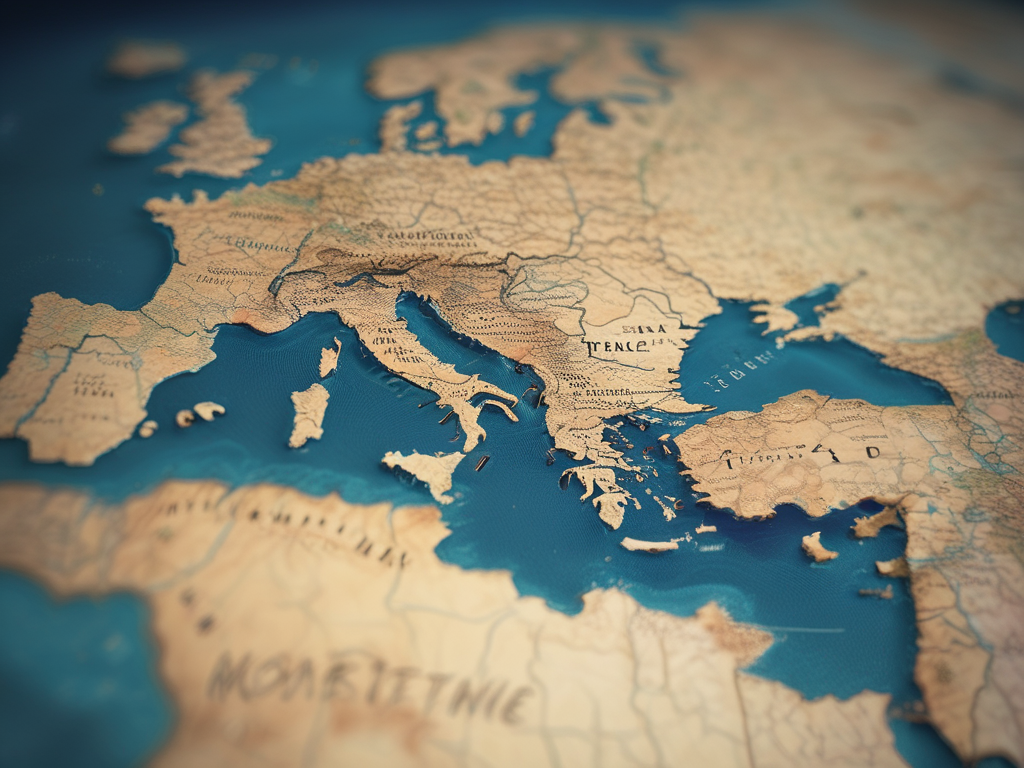
Where is Carthage Tunisia?
Carthage sits along the Gulf of Tunis in Tunisia, in the north of Africa. Carthage (Tunisia) is only 200 miles from Sicily (Italy). The proximity of these two countries is what helped Carthage to gain such importance in the trade route. Any ship passing through the Mediterranean Sea was forced to squeeze between this small section.
Nowadays, Carthage is considered a section of Tunis, Tunisia’s capital city. It is to the east of the city center along the coast, nestled between the neighborhoods of La Goulette and Sidi Bou Said.
Going to Tunisia soon? Get Ready at a glance:
Get travel medical insurance with SafeyWing.
Book your stay with Booking.com.
Check Flights with Skyscanner or Hopper.
Rent a car with RentalCars.com.
Download the Airalo app and get a Tunisian eSIM.
Take a tour with GetYourGuide or Viator.
Have a 1:1 consultation with me in advance!
Read More: 31 Things to Do in Tunisia
Carthage Tunisia in One Day
When you look at Carthage on a map, you may feel overwhelmed due to the size and locations of each archaeological site. They are quite spread apart. Like us, I imagine you don’t want to walk a long distance without knowing exactly what you’re about to see.
It is very possible to see the most important sites of Carthage in one day, or even half a day. In this guide, I’ll give my opinions on which are the best and worst sites on the multi-site ticket, and whether certain places are worth it. I’ll give you the best advice for how to conduct your day, where to start, what to know about each location, and even where to eat lunch along the way.
There are also many more Carthaginian sites to visit within this area, however, I will be focusing on the locations that are specifically included in the multi-site ticket. You could spend an entire extra day visiting all of the other sites that are not included in the ticket such as the Ruines du monastère Saint Étienne, Quartier Punique de Byrsa, and the Ancient Punic living quarters, etc.
Read More: 25 Things to do in Tunis
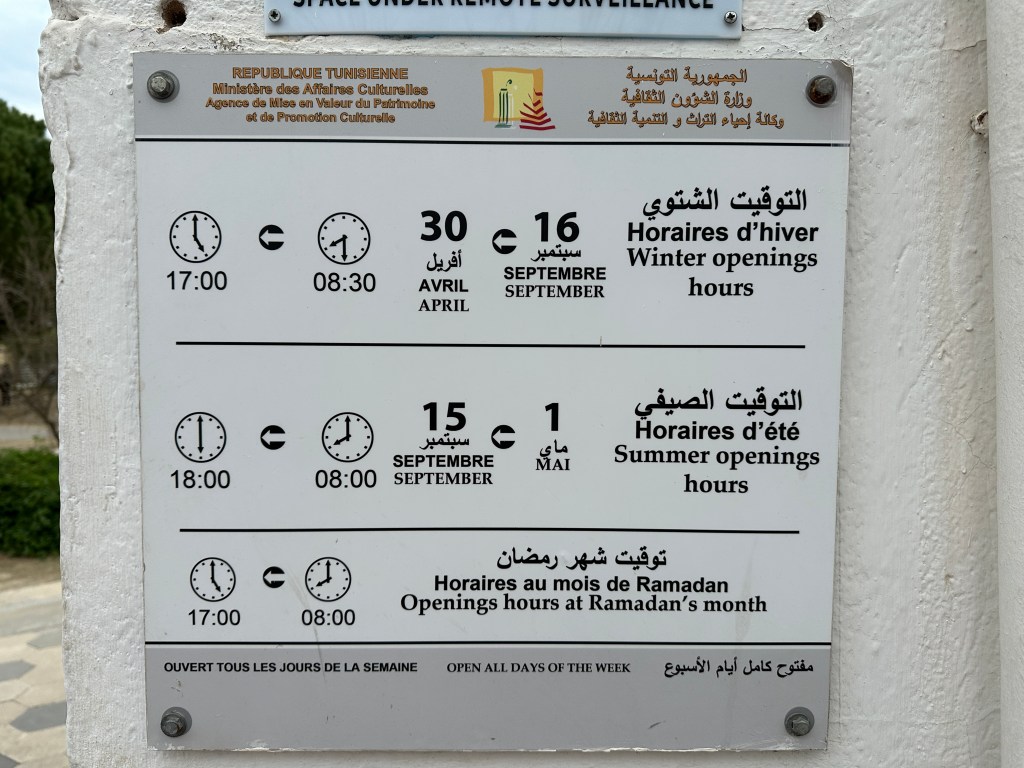
Carthage Tunisia Opening Hours
Depending on when you visit Carthage, the hours will change slightly. The opening hours are important to know, as it will help you to plan your one-day itinerary. The Carthage Archaeological sites are open every day of the week.
Winter Hours
September 16 – April 30
8:30 am – 5 pm
Summer Hours
May 1 – September 15
8 am – 6 pm
During Ramadan
8 am – 5 pm
The Carthage Multi-Site Ticket
The cost of the multi-site ticket is 12 TND (4 USD). You can purchase this ticket from any of the site entrances, and you must pay in cash. Present the ticket at each consecutive site and they will cross off that location. The ticket is only valid for one day. You cannot spread your visit over multiple days using the same ticket.

There are 8 official sites included in the price of the Carthage multi-site ticket, which are listed below in the order they should be visited.
- Amphithéâtre (Amphitheatre)
- Théâtre Romain (Roman Theatre)
- Villas Romaines (Roman Villas)
- Thermes d’Antonin (Baths of Antonin)
- Quartier Magon (Magon Quarters)
- Musée Paléochretien (Paléochretien Museum)
- Punic Port (not listed on the ticket)
- Tophet de Salambo
- Musée de Carthage (interior closed until 2027)
How can I get to the Carthage Site in Tunis?
If you don’t want to walk or take a bicycle tour, it is fairly easy to catch a yellow taxi in Tunis along the main roads or to order a Bolt (like an Uber). You could take a Bolt or taxi between each location.
There is also a train that goes from the Tunis city center to La Marsa, with several stops throughout Carthage. The two most important train stations that you’ll be using today are:
Carthage Hannibal (closest stop to the Roman Theatre)
Salammbo (closest stop to the Tophet de Salambo)

North to South Itinerary
If you want to start the day at the Théâtre Romain (and skip the Amphithéâtre), it is an 8-minute walk from the Hannibal Carthage train station.
If you want to start the day at the Amphithéâtre, it is a 20-minute walk from the Hannibal Carthage train station.
Take a look at the map below to help make this make more sense.
Depending on where you are staying in Tunis, I suggest taking a taxi or a Bolt to the Amphithéâtre to begin your day. From there you can walk to the Théâtre Romain, which takes about 20 minutes. Then you can walk to each site as you continue south.
The last stop on this itinerary will be the Tophet de Salammbo. From there you can head to the Salammbo train station to return to your accommodation. Take a taxi or Bolt if you’re tired.
South to North Itinerary
If you want to start at the most southern point and work your way north, take the train to the Salammbo station. From there it is a 7-minute walk to the Tophet de Salammbo.
You will then continue north along the path to visit the remaining sites. Your last stop will be either the Théâtre Romain or the Amphithéâtre.
Ultimate Carthage One-Day Route (Carthage Map)
This map of Carthage shows the route you can easily take during the one-day itinerary around the archaeological site. You can go either way: north to south, or south to north.
I did not include the two museums on this map because I don’t think they are worth it. One of the museums is closed until 2027. Rather than visit these two museums, I suggest visiting the Bardo Museum instead, as it is very large and well organized. It showcases several mosaics and other items found in the Carthage excavation sites.

Carthage Tunisia 1-Day Itinerary
Below is the ultimate one-day itinerary for visiting the Carthage archaeological site in Tunis on your own. The day that I visited Carthage, I had 18,220 steps, so make sure to wear comfortable footwear. I have organized this itinerary to maximize your time so you can see all the most important sites.
I will also be honest about which things are worth seeing and which places you can skip if you don’t have a lot of time.
You might also be surprised at the lack of preservation taken towards protecting each site. Visitors are allowed to walk on, climb on, and touch everything.
Another funny/interesting thing to note is that if you post about the Carthage site on social media and mention anything “Roman,” then Tunisians will come for you in the comments. They are in denial that anything Roman ever existed on this land.
Read More: The Perfect 10-day Tunisia Road Trip Itinerary
Amphithéâtre
The Amphithéâtre is a 20-minute walk from the Roman Theater.


What is the Amphithéâtre?
This amphitheater was built in Carthage by the Romans in the first century. It is said that the reason there is so little structure remaining is that pieces were stolen to construct other surrounding buildings.
What does the Amphithéâtre look like now?
A lot of the Amphithéâtre is now in rubble. The perimeter wall is oval and is the most intact part of the site. You can walk on top of the wall. Within this oval, you can find several broken columns and partly built structures.
There is a trench that goes through the center. At one end is a cave that seems like it was once a holding cell. At the other end is a renovated room with interesting floors, however, that room was locked when we were there. There is a small tunnel that connects with this trench.
You can walk to the end of the tunnel and find yourself inside another room (see the photo above). You can take cool photos from up above looking down into the room.
Cool Factor of the Amphithéâtre
7/10
The Amphithéâtre was interesting to see, but if I didn’t have much time, I would be fine to skip it. It all felt very crumbling. It’s more interesting than several of the other sites but can be cut out if you don’t have time due to its distance.
Insider Tips to Visiting the Amphithéâtre
The best overall view of the Amphithéâtre is from the west side, opposite the entrance. I noticed that other visitors entered, walked to the other end, and left. To maximize your time here, you should explore a bit. The tunnels were cool, but I noticed that we were the only ones to enter them. Exploring the site makes it more interesting.
Théâtre Romain
If you don’t want to visit the Amphithéâtre, then the Théâtre Romain (Roman Theater) is where you should start. It takes less than 10 minutes to walk here from the Hannibal Carthage train station.


What is the Théâtre Romain?
The Théâtre Romain was built in the second century AD and was used for performances such as philosophy debates and poetry readings. It was constructed while Carthage was under Roman control. The Théâtre Romain was able to seat up to 5000 spectators.
What does the Théâtre Romain look like now?
The Théâtre Romain is very much intact still. It is obvious that the government has restored many sections, and it is very usable as a theatre. There is a stage, lights, and other infrastructure that shows it is still used.
Some of the stairs/benches were obviously renovated, and other parts seemed to resemble the original state. The Théâtre Romain is in great shape.
Cool Factor of the Théâtre Romain
9/10
The Théâtre Romain is necessary to visit on your one-day Carthage itinerary. It was very impressive and fun to walk around in.
Insider Tips to Visiting the Théâtre Romain
We got to the Théâtre Romain early in the morning and had the place to ourselves. It was great to walk around and even play fight inside the theatre without anyone else around.
There are bathrooms at this stop.
Villas Romaines
The Roman Villas are down the street from the Roman Theatre, about 5-10 minutes on foot.


What are the Villas Romaines?
The Roman Empire began colonizing Carthage in the first century AD. The wealthier Romans living in Carthage began to construct their villas in this spot. The most famous villa is the Kobba Bent el Rey, which is the main building in the area.
What does the Villas Romaines look like now?
The Villas Romaines take up a large area of land. There are a few paths made from flat white stones that you can follow around the site. The majority of the original structures are barely standing. There are very few informational boards around the site and the ones that are there are extremely faded.
In the center, there is a larger building that you can walk up to. They are doing some renovations there. From the balcony of this building you have a great view of the site, and the sea in the distance. You can find some Roman sculptures and floor mosaics here.
Cool Factor of the Villas Romaines
5/10
It was interesting to see the Roman villages that were built after the fall of Carthage, but because they were in such a state of disrepair, it was hard to have a good idea of what they truly looked like.
Insider Tips to Visiting the Villas Romaines
There are no bathrooms at this site. You don’t need to spend much time here besides a quick stroll through the area. The best views are from the top of the building in the center that is being renovated.
Thermes d’Antonin
The Thermes d’Antonin (Antonin Baths) is on the opposite side of the main road from the Roman Villas and Roman Theatre. It sits right along the water.


What is the Thermes d’Antonin?
The Baths of Antonin were built during the reign of Rome’s Antoninus Pius, in 157 AD, which are currently listed as a UNESCO World Heritage Site. These are the largest Roman baths built outside of Italy. This park area was actually much more than just baths. There were also meeting rooms and communal areas. Women came in the morning and men came in the afternoon.
What do the Thermes d’Antonin look like now?
The Thermes d’Antonin is one of the best-preserved sites within the Carthage archaeological area. While a lot of the structures are crumbling, there are still several that are intact. You can get a good idea of what things were like as you walk through the site.
We were mostly alone at the other sites, but here we saw several other tourists and tour groups, understandably. There are several informational boards around the area to provide more history and context to the site. Some illustrations on the boards show what it looked like originally, which is really helpful.
You are allowed to walk on top of the structures and touch everything here, which was kind of surprising.


Cool Factor of the Thermes d’Antonin
10/10
This is easily the best site in the entire Carthage Tunisia area. The structures are standing, and the views are amazing. If you only have time for one stop, make it this.
Insider Tips to Visiting the Thermes d’Antonin
Because this is the most visited site in Carthage, you should expect to see more tourists here. If you come early there is a better chance to have it to yourself. There are bathrooms here, as well as a small cafe where you can get coffee, chips, or sweet treats. Make sure you have cash though.
There are a few stands outside the entrance where people are selling souvenirs.
Quartier Magon
You can find the Quartier Magon just a few blocks away from the Thermes d’Antonin.


What is the Quartier Magon?
This area was originally a space for residential housing of Punic artisans. Later, after the Punic Wars, Romans built workshops and houses on top of the Punic homes.
What does the Quartier Magon look like now?
The Quartier Magon is basically a large open field. There are a few large holes where there were once homes. That’s about it. You have a great view of the sea from here. That said, the path along the water next to the Quartier Magon is more interesting and beautiful than the site itself.
Cool Factor of the Quartier Magon
2/10
We stopped here because it was included in the ticket but there wasn’t much to see. We stayed for less than 10 minutes. If you don’t have time, you can skip this site.
Insider Tips for Visiting the Quartier Magon
There is a path along the water next to the Quartier Magon that you should walk along. There are no bathrooms here.
Musée Paléochretien
The Paléochretien Museum is next to the main street and the train tracks.
What is the Musée Paléochretien
This is a small museum to showcase mosaics from the excavation sites in the area.
What does the Musée Paléochretien look like now?
This is a very small museum with a few broken mosaics and pieces of pottery inside. Outside you can find a few small excavation sites. There isn’t much to see.
Cool Factor of the Musée Paléochretien
1/10
You don’t need to go here. The museum is so small and doesn’t offer much information. If you’re planning to visit the Bardo Museum in Tunis, this small museum is skippable.
Insider Tips to Visiting the Musée Paléochretien
You don’t need to spend much time here. There is a bathroom here.
Punic Port
The Punic Port is a circular waterway between Tophet de Salambo and the Quartier Magon.


What is the Punic Port?
This was once one of the main ports used by ancient Carthage. It was used for both trading purposes and by the navy.
What does the Punic Port look like now?
It’s a very small circle of still water. There were several small boats tied up around this old port. If you didn’t know, you could easily walk right by this old Punic port and not realize it had any historical significance.
Cool Factor of the Punic Port
4/10
It was interesting to see the man-built port and learn that it once had such importance for trade with the Carthaginians.
Insider Tips for Visiting the Punic Port
It was free and not included in the ticket because it is outdoors. It was on our way in between the Quartier Magon and the Tophet de Salambo so we made sure to pass by. There are street names in the area related to history such as Rue Hannibal.
Tophet de Salambo
You can find the Tophet de Salambo a few blocks past the Punic Port. It is in what seems like a very wealthy neighborhood.


What is the Tophet de Salambo?
This is an ancient Punic site honoring their gods Tanit and Baal. There are several tombs for children at this location. It was once interpreted to mean that they sacrificed children here, however, that idea has is not fully confirmed.
What does the Tophet de Salambo look like now?
The Tophet de Salambo does not take up a lot of space. It is in a small area with a lot of overgrown grass and plants covering the previously existing structures.
Several concrete blocks are lying around that look like tombstones. There are no informational boards around the area to understand what happened here.
Cool Factor of the Tophet de Salambo
4/10
It was interesting but because of the lack of information there, hard to understand what anything meant. The area was small and was not as impressive as other sites such as the Roman Theatre or the Thermes d’Antonin.
Insider Tips for Visiting the Tophet de Salambo
The entrance to the Tophet de Salambo is on Rue Hannibal. Google Maps originally took us to the other side of Tophet de Salambo, on Rue Jugurtha, but the gate on that side is closed. There are no bathrooms here.
Musée de Carthage
What is the Musée de Carthage?
This is a museum that showcases the pottery and statues from the excavations in the area.
What does the Musée de Carthage look like now?
It is a museum with artifacts both inside and outside of the museum. There are a few remaining structures, columns, and sculptures on the grounds outside.
Cool Factor of the Musée de Carthage
1/10
Again, I don’t think this museum is worth your time. Visit the Bardo Museum in Tunis to see the mosaics and history of the region. You can see some columns outside the museum, but you will see better versions at the Thermes d’Antonin.
Insider Tips for Visiting the Musée de Carthage
The interior of the museum is closed until 2027 so you will only be able to visit the exterior part of the museum.
Half Day Walking Tour
Looking to shorten your day and just visit the most exciting sites in ancient Carthage? I got you covered. Here is a list of the Carthage highlights:
- Roman Theatre
- Amphithéâtre
- Thermes d’Antonin
- The walkway along the water next to the Quartier Magon
Guided Tours to Carthage
If you’re looking for a guided tour that can provide you with more information about the site, here are a few great options:
- Carthage: Walking Tour of Archaeological Sites and Ruins
- Carthage: Guided Bike Tour of the Archaeological Site
- Private Tour of Carthage
- Private Tour: Tunis Medina, Blue Sidi Bou Said, Carthage
- Tunis: Medina, Carthage, Sidi Bou Said, Bardo Private Tour
Where to Stay in Tunis
Are you looking for somewhere to stay in Tunis? Here are a few great options in the nearby neighborhoods of Sidi Bou Said, La Marsa, Medina, and of course in Carthage.
Read More: Where to Stay in Tunis: Best Neighborhood Guide
Sidi Bou Said
Sidi Bou Said is the most well known neighborhood in Tunis due to its blue and white buildings. It tends to be on the bougier side of things. It is not far from Carthage and very easy to travel between the two areas via train, taxi, or Bolt.
Check availability for this LUXURY HOTEL in Sidi Bou Said
La Marsa
La Marsa is the beachy neighborhood further north along the coast, past Sidi Bou Said. There are great restaurants and coffee shops. It is where the train ends, so you can easily reach Carthage from La Marsa. This is where I stayed in Tunis.
Check availability and BOOK this hotel in the perfect location.
Carthage
If you decide to stay in Carthage, you will be surrounded by history. Reaching the Carthage sites will be very easy on foot, or even by train depending on where you are based.
BOOK NOW to stay at La Villa Didon, just 5 minutes from the Roman Theatre
Medina
Staying inside the medina is definitely a cultural experience. You can easily take the train from the center of Tunis (10 minutes walking from the medina) to Carthage.
BOOK NOW to Stay in a traditional Tunisian home in the medina
Carthage Tunisia FAQs
Have some more questions about visiting Carthage Tunisia? I’ve got your answers here.
Where should I begin the Carthage site tour?
I suggest doing the North to South Itinerary. This way you can start the tour with some of the cooler sites and work your way to the best site, Thermes d’Antonin, right in the middle.
However, if you prefer to start at the Tophet de Salambo and work your way north, then you’ll be able to end the itinerary at the Roman Theatre, which is a great denouement.
The most important thing is to organize yourself first. If you just start in the middle without a plan, you’ll find that it can be challenging to cover the necessary ground and see everything. Things are very spaced out within the area of Carthage.
Are there bathrooms in Carthage?
Yes, some of the sites have bathrooms:
- Both museums
- Roman Theatre
- Thermes d’Antonin
Some sites do NOT have bathrooms:
- Amphithéâtre
- Roman Villas
- Quartier Magon
- Tophet de Salambo
Can you buy food in the Carthage sites?
The only place where we found food within the Carthage archaeological area was at the Thermes d’Antonin. There is a small cafe that serves a very simple menu of coffee, chips, brownies, etc. You must pay cash.
Where can I eat lunch in Carthage?
We stopped at a Tunisian street food stand along our journey, which I can highly recommend. It is called Am El Matri. The food was delicious and very affordable. Cash only.
Read More: Guide to Tunisian Street Food


What should I wear to visit Carthage?
The most important thing you should wear on the day you visit Carthage Tunisia is comfortable shoes. As I mentioned, I walked 18,220 steps on the day I went, so wearing good shoes was a necessity.
Beyond footwear, make sure you are prepared for the elements during the season you visit. You’ll be out all day, so you may want a light jacket in the morning that you will take off later in the day when/if the sun comes out.
A few other items to bring with you:
- SPF
- Wear a hat if you’re sensitive to the sun
- sunglasses
- cash
- a small backpack to carry your layers
Is Carthage worth the visit?
Yes, visiting Carthage Tunisia is worth it. There is so much interesting history to learn about here. There are many excavation sites and ancient structures.
Within the archaeological sites, some locations are more worth it than others. The best sites within Carthage are the Roman Theatre and the Thermes d’Antonin.
That said, the Tunisian government unfortunately does not take that much caution to protect the sites, so I worry about how impressive some of them will be in the future. If they continue to allow tourists to climb all over everything, I’m afraid they will become even more difficult to preserve.
Final Thoughts on Carthage Tunisia
A trip to Tunis is not complete without visiting the Carthage archaelogical sites. This is where you will find the thousands year old history of the area. Whether you plan to spend one week in Tunis or just a weekend in Tunis, you must absolutely add a visit to Carthage to your Tunisia itinerary.
If you only have a couple of hours, make sure to visit the Thermes d’Antonin and the Roman Theatre. But if you want to dig deeper into the history of Carthage, you have unending possibilities.
Feel free to pin the photos below to save for later.


TRAVELING SOON?
INSURANCE: Cover yourself with travel medical insurance by SafetyWing.
FLIGHTS: Get the best flight deals with Skyscanner and set flight alerts with Hopper.
STAYS: Check out hotels and apartments with Booking.com and Vrbo.
RENTAL CARS: Get the best deal on rental cars with Discover Cars or RentalCars.
GOING HIKING? Get a 30% discount off your yearly AllTrails+ Account (code: nickiposts30)
eSIM: Get an international eSim with Airalo.
CITY GUIDES: Save time and purchase pre-made city guides with Thatch.
CITY TOURS: Book your tour with GetYourGuide and Viator
LUGGAGE: Get the best carry-on suitcase here.
CREDIT CARD: Start earning travel points with the best travel credit card.
BUENOS AIRES GUIDE: Purchase my Buenos Aires travel companion here.
CONSULTATION: Book a 1:1 travel consultation with Nicki here.
SUBSCRIBE: Get the Nicki Posts Travel Stuff newsletter every month.
TRAVEL BETTER: Check out my Travel Tips and best Travel Resources pages.
MORE? Check out more on my LINKS page to find me in more places!



You must be logged in to post a comment.