Complete Guide to Renting a Car in Tunisia (2025)
Doing a road trip around Tunisia is the best way to see the country. This guide will teach you everything you need to know about car hire in Tunisia.

If you’re considering renting a car in Tunisia, you’ve come to the right place. I rented a car in February 2024 with two other friends to do a big road trip around Tunisia. We went to the most northern tip of Africa at Ras Angela, down to the deserts of Tozeur and Tatooine, and several stops in between. The road trip was my favorite week of the two months I spent in Tunisia.
If it weren’t for having our own set of wheels, we definitely wouldn’t have been able to see several things that we did. We made our schedule and never had to worry about public transportation or timetables. If you can, I highly suggest renting a car during your trip to Tunisia.

Read more: 21 Things to Know Before Coming to Tunisia
Renting a car in Tunisia
We did a lot of research before starting on our Tunisian road trip like where to visit, which cities and ruins to see, where to sleep, and most importantly, which car should we choose? We ultimately decided to go with RentalCars.com, which was a wise choice in the end. They were very helpful when filing an insurance claim (more on that later).
🚙 Book Your Rental Car in Tunis HERE 🚙
Pick up your rental car at the Tunis-Carthage airport!
Renting a Car vs Public Transportation
When traveling to a new country, one of the main questions I find myself asking is “How will I do the actual traveling part?” Should you rent a car? Use public transportation? Taxis? Private intercity taxis? During my two months in Tunisia, I did a bit of both, as it suited my needs.
Before arriving in the country, my Tunisian friends kept saying I needed to have a car because public transportation is bad. However, I didn’t want to rent a car for two entire months as that would be quite costly. The best thing to do is to consider what you want to do and what is a priority for you.
Renting a Car
Renting a car was necessary for our road trip as we wanted to make several stops in the middle of nowhere, get to places where public transportation didn’t go, and make our own schedules. Some of my favorite places to visit on the road trip were places that required a car as public transport didn’t go there.
Renting a car will be more expensive than taking public transportation. But you should also think of the convenience of private transportation, and the time you want to spend on dealing with buses, trains, and louages, etc.

Public Transportation
While hiring a car in Tunisia was very convenient, I found public transportation to be very reliable when going from one city to the next for a day trip. If you only plan on going to main cities and hubs, then you should be fine with public transportation only.
There is one train line that goes from Tunis to Metlaoui, with several stops in between, including El Jem and Sousse. The trains are always delayed and not reliable, however. There are also buses between some major cities, but I also found them to be a bit inconvenient. The best mode of public transportation in Tunisia is the louage, which is a shared passenger van. I wrote a whole blog post about how to take a louage in Tunisia.

Going to Tunisia soon? Get Ready at a glance:
Get travel medical insurance with SafeyWing.
Book your stay with Booking.com.
Check Flights with Skyscanner or Hopper.
Rent a car with RentalCars.com.
Download the Airalo app and get a Tunisian eSIM.
Take a tour with GetYourGuide or Viator.
Have a 1:1 consultation with me in advance!
Why is renting a car a good idea in Tunisia?
There are so many reasons why it is a good idea to rent a car in Tunisia. Tunisia, like the US, is very much a car-based society. I found gas to be quite affordable as well. There are so many amazing places to see around Tunisia that you wouldn’t be able to see without a car such as Ras Angela (Africa’s most northern point), the Dougga Ruins (an ancient Roman and Numidian town), several Star Wars filming locations in the south, etc.
We loved having the freedom to explore on our own, go at our own pace, and make stops whenever we felt like it. Like once, for example, we saw a herd of camels crossing the street in the desert, so we stopped to watch them for a while.

Read More: 31 Things to Do in Tunisia
What kind of car should I rent?
For our one-week road trip, we rented a 4-door sedan, and it was perfect for our needs. There were three of us, so we were all comfortable with the space and had plenty of room in the trunk for all of our bags and suitcases. We even had extra room to buy some carpets and souvenirs along the way.


If you plan on driving deep into the desert and going off-roading, then a 4×4 might be the best option for you. That said, it will be more expensive and take more gas. You won’t need such a strong car for the majority of places in Tunisia. Therefore, I suggest getting a mid-size sedan or hatchback for your road trip. Then, if you really want to go deep into the desert, just organize a one-day tour on quad bikes or camels.
What is the best season to rent a car?
Because Tunisia has more of a desert/beach climate, you won’t necessarily find a ‘bad’ season to rent a car, in terms of weather conditions. However, it will be more expensive in the summer than in the winter due to the sheer number of incoming tourists in the country. Just keep in mind that January and February are the rainy months, so make sure the windshield wipers are in good shape.
I always recommend traveling in the off seasons, or the shoulder seasons of the regular tourist season. This is due to both experience and cost. More people traveling means higher costs and more crowded places. Fewer tourists mean lower costs and more authentic travel experiences.
Read More: 7 Best Tunisia Beach Towns

How much does it cost to rent a car in Tunisia?
Our car rental in Tunisia cost us $250/week, everything included (except gas). Because we were three people, it was even more affordable, as we were able to divide up the costs. You should expect the prices for the same car (economy sedan) to rise in the summer months.
How do I rent a car?
Car hire in Tunisia was pretty simple. Below I will lay out the steps to take to help you feel a bit less overwhelmed.
Find the company that works for you
Check online and compare prices for big car rental companies like Hertz, Budget, Europcar, etc. to see the difference in prices and styles for your needs. I find the rental aggregators to be the most efficient, such as DiscoverCars and RentalCars.com as they sort through all of the car companies to find the best deals.
We ultimately went with RentalCars.com as they had the best prices for what we needed; we got the best deal from Budget using RentalCars.com. As I’ll explain later, we got some scratches on our rental car and needed to submit a claim to insurance. RentalCars.com had great customer service and was instrumental in getting the documents that we needed.
Make an online reservation
Once you find the car you like, click that reservation button, and fill out your details.
One nuanced thing we noticed was that the price changed depending on who filled out the information. Initially, my Brazilian friend filled out his info, and the price was $200. Then we realized that I was the one who needed to put in the info details (because we were using my credit card), and the price changed to $250 when I changed my nationality to American.
Pay with a good credit card
The best thing we did for ourselves on this trip was rent the car using my Chase Sapphire credit card. This is because the Chase Sapphire card includes rental car insurance. You need to make sure to decline the rental insurance directly with the car company to be able to access the Chase Sapphire rental insurance. This was the first time I had ever needed to use car rental insurance, and I was so glad I had it.
Pick up the car
The easiest thing to do is rent a car at the Tunis airport, as that is the location where you will most likely be entering first. The Tunis airport is also close to the center of the city, so even if you aren’t picking up your car right away, it is still easy to get back there to grab it and drop it off.
Keep in mind that there may be a language barrier. Tunisians speak Arabic and French, however, because the car rental workers are used to dealing with tourists, they often speak several other languages, especially English.
The majority of the car rental companies have a counter on the main floor of the Tunis airport. Some companies, however, will require you to meet them at a particular section of the airport parking lot. That was the case with Budget as they did not have a counter inside. They gave us a phone number to call once we arrived and then met us in the parking lot.
Record previous damage
Once you meet your car rental employee, you’ll do a walk-through with them, looking at both interior and exterior damage. They will also take note of the current gas level. You need to return the car at the same level as you received it. They don’t always fill the gas to the maximum before giving you the keys.
I suggest taking a video as you walk around the car, noting previous scratches, scrapes, and bumps to the car. I also suggest checking the windshield wipers before driving away. We didn’t do this, and ended up with a very bad wiper on the driver’s side, making the driving a bit more challenging during the rain.
Sign documents
As you would anywhere else in the world, you’ll need to sign the rental documents stating that you agree to the terms and the days/times of the rental. Make sure to return your car at the prompt time, or you may be charged a fine. Keep the documents in the glove box along with the registration and insurance for the car.
Leave the parking lot
Once you have assessed the previous damage, and signed all the documentation, it’s time to leave the Tunis airport. The car rental employee will give you a small ticket. Take that ticket to the parking meter boxes near the exit. You need to pay to exit. It cost just a couple of Dinars.
Enjoy your Tunisian road trip
This is the best part. Explore all that Tunisia has to offer, which is a lot. Below I will offer some tips for driving in Tunisia, as well as common habits of Tunisian drivers. Keep reading!
Return the car
Make sure to arrive back at the Tunis airport to return your car rental promptly. They may charge you a fine if you return the car later than originally promised. Rental days are in 24-hour increments. So if you pick up your car at 10 am, you need to return it by 10 am as well.
Once you park, call the same phone you were given with your reservation, and the attendant will meet you at the car. They will take a look around the car to assess any new damage and check the gas levels to ensure they are the same as when you received the car.
If there is nothing wrong, this process will be very quick. If there is damage, you should expect a longer return, so allow yourself time if you need to catch a flight the same day. Down below, you will see the steps to take if you do return your car with damage (like we did).
Going to Tunisia soon? Get Ready at a glance:
Get travel medical insurance with SafeyWing.
Book your stay with Booking.com.
Check Flights with Skyscanner or Hopper.
Rent a car with RentalCars.com.
Download the Airalo app and get a Tunisian eSIM.
Take a tour with GetYourGuide or Viator.
Have a 1:1 consultation with me in advance!
How do I fill up with gas?
The main gas stations in Tunisia are Petrole Tunisie, Ola, StarOil, and Shell. In big cities, you can easily find a gas station on nearly every corner. In the desert areas, gas stations will be more sparse, but we were still able to fill up when necessary without issues. I suggest filling up your tank before crossing big stretches of the desert though, like the Chott el Djerid.
When you go to the gas station, you do not need to pump your own gas. Just pull up to a pump, and an attendant will come to you. Tell them what kind of gas you want, and how much, and they will do the work for you.
We found that the majority of gas stations allowed us to pay with a credit card, though every once in a while, cash was the only option. Make sure to ask in advance before getting gas, if you can pay with a card if you think this will be an issue for you. We were able to fill up our 4-door Sedan for 100 TND (30 USD).
What is it like to drive in Tunisia?
Each country has their own nuanced way of doing things when it comes to driving, and Tunisia is no exception. Below I’ll list out some things to look for while driving in Tunisia.
Paying tolls
The majority of main roads and highways in Tunisia require you to pay at the tolls. They are usually inexpensive, but you need to make sure to have exact change ready. Cars quickly form a line at the toll booths if you are not quick to hand over your money. Sometimes they even start honking, which can be a stressful experience.
To mitigate the stress, I suggest having a small bag or cup full of Dinar coins in the car, so that you can quickly pay when you reach the window. The prices will usually be posted just before the window. But be careful because we were ripped off a few times at these windows. When we handed over the money, the attendant said it was a higher price. When we gave him more money, he didn’t give us the change and then pretended he didn’t understand when we asked for it.
Speed bumps
There seem to be speed bumps everywhere along the roads in Tunisia, especially when entering or exiting small towns. Most of them are painted yellow, but sometimes the paint has faded, and you notice there is an approaching speed bump all too late. Just keep that in mind and don’t go too fast when you’re not on the highways. They suddenly appear out of nowhere.
Poorly maintained roads
The highways are usually in good shape, but the smaller roads in Tunisia are often full of holes and cracks in the road. In combination with the speed bumps, driving in Tunisia can be a bit annoying. You need to be constantly vigilant. There are also a lot of large trucks that drive on small two-laned roads, so get your patience ready when you get stuck behind them.
Traffic stops
There seems to be an unusual amount of traffic stops around Tunisia. You will see police standing on the side of the road often, but particularly when crossing from one governate (like a state or province) into another.
Most of the time you just need to slow down and they’ll wave you through when they see you’re a foreigner. A couple of times we did actually get waved over to the side of the road and were asked to show our passports. Make sure to bring your passport on the road trip with you for ease during these stops.
One thing we noticed was that when I was driving (white woman with blue eyes and light hair), we were waved on through without needing to stop. When my French Canadian/Lebanese friend (dark features, looks more local) was driving, we were asked to pull over to show our identification.
Local Tunisian driving habits
Tunisians have their own set of driving rules that you should be aware of before beginning your journey. However just a warning, even if you’re aware, they will still probably drive you bonkers.
Tunisians don’t use blinkers
This is common in a lot of countries, but Tunisians are not big fans of indicating when they turn. This can come as a surprise when the car in front of you suddenly slows down and turns without warning. To adjust, I suggest keeping a safe distance from the car in front of you.
Tunis usually has pretty bad traffic during rush hour times (8am – 10am, and 4pm – 7pm). Traffic gets pretty backed up and you will come to a standstill on major routes. You should also be aware when driving in the bigger cities, that cars will often dash across multiple lanes to take their exit, always without using an indicator.
Tunisians drive between two lanes
This is one driving habit I will never understand. When driving behind a Tunisian, you will notice that they don’t choose the right or the left lane. They choose both, making it impossible to pass them. I honestly will never understand this, and it is crazy-making. But Tunisian drivers absolutely adore driving with the dotted lines directly under the center of their cars, sometimes for miles.
Tunisians walk in the street
As you drive around Tunisia, you’ll notice that there are pedestrians everywhere all along the roads. Even on busy highways, you will see people run across the street, or even just hanging out in the medians.
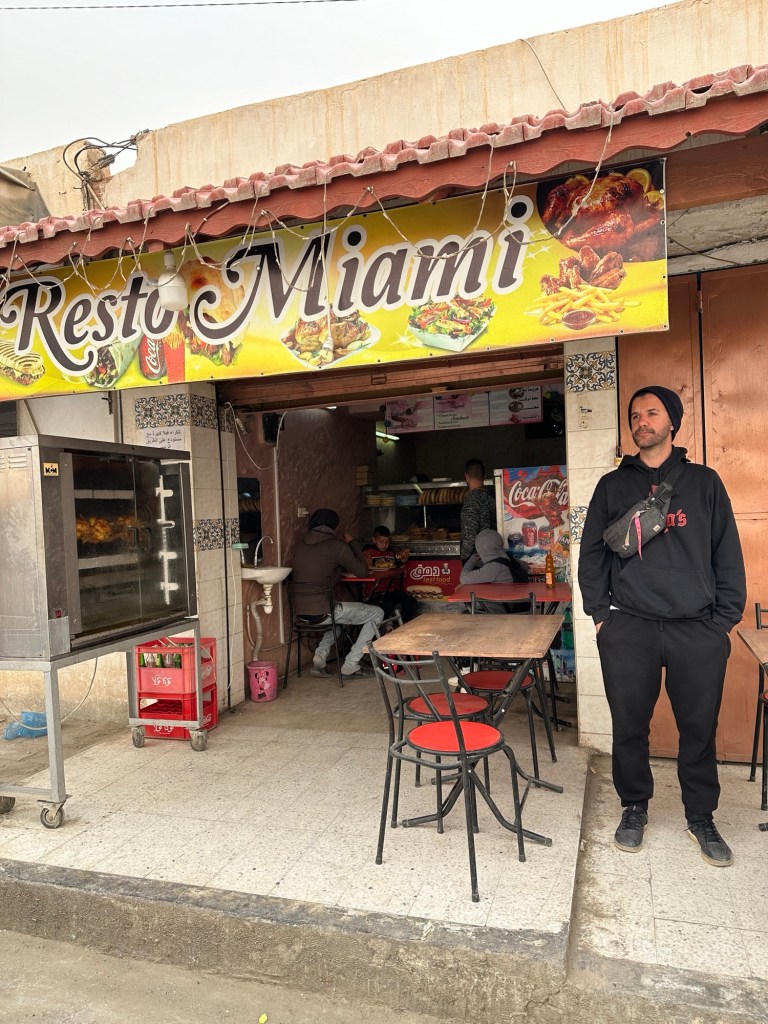
Sometimes an intercity road becomes the main street once you reach a smaller town. This happened several times; as we entered a new town, the road we were on was the main street of the city market. We had to inch along as we passed by fruit vendors and butchers selling their goods to the locals who were all casually walking in the street. There are also several small Tunisian street food restaurants along the main roads.

Should I get insurance to drive in Tunisia?
The short answer is yes, you should get insurance when you drive in Tunisia. The roads aren’t great, the drivers can be unpredictable, and you just never know what can happen. If you don’t get rental insurance because you don’t want to pay an extra $50, you may end up paying hundreds or even thousands more.
In order to get free car rental insurance, I suggest using your Chase Sapphire credit card, or any other credit card that has it included as a perk. If you use your credit card with car rental insurance, don’t forget to opt out of the rental company’s insurance. If you don’t have a credit card like that, I suggest opting in to the rental company’s insurance.
If you’re looking for general travel medical insurance in case anything happens to you personally, I recommend SafetyWing. It is one of the most affordable travel insurance companies available on the market.
What if something happens to my rental car in Tunisia?
If you rent a car in Tunisia, and something happens to that rental, you might be wondering what to do next. Well, don’t worry, because something did happen to our rental car, so I’ll walk you through what actions to take step by step.
All the information provided below is based on my experience with Chase Sapphire, RentalCars.com, and Budget in Tunisia. If you use a different company/insurance, your experience may differ slightly.
What happened to our rental car?
When we visited the Star Wars filming location of Mos Espa near Tozeur, my friend parked the car in the “parking lot.” This lot was a vaguely marked area with a few 3′ grey poles, most of them damaged or missing. When we got back in the car to leave, I was in the driver’s seat. Because I wasn’t the one who parked, I didn’t have full spatial awareness. I didn’t know, and couldn’t see, the small grey pole on the passenger’s side.
I didn’t see any other poles nearby, so I thought we were in a section that didn’t have them. I started to pull away slowly until I heard the sound of metal on metal. I got out to check the damage and then spent the next couple of days very stressed out. In the end, everything worked out, and my car rental insurance with Chase Sapphire covered everything.


Document the damage
As soon as the accident happens, make sure to document everything. You will need at least 2 photographs when you submit your claim to the insurance company. Take a photo of the damage on the car, the thing you hit, the scenario in which it happened, the other car if there is one, etc.
Call the Police
Depending on the situation, you may need to call the police to get an accident report. Fortunately, in my case, I did not have to do this since it was just an already damaged pole, and there was no criminal activity, or bodily harm done.
Contact the insurance company
You should contact the insurance company if you have any questions or need to figure out any details. You can also just go straight to the claims portal and submit your claim at eclaimsline.com once you have your documents in order. Select “Start a claim.” You will log in and then upload all of the required documents (listed further down below).
Visa claims: 1-800-320-9961
Benefits/Insurance: 1-866-386-5888
Travel line: 1-866-331-0773
Report damages when you return the car
When you return the car, the attendant will look around the car for damage. At this point, you can show them the damage. In our case, the attendant noticed right away. Make sure to gather all the necessary documents from them. It may be a challenge. Budget did not give us all the necessary documents and I needed to follow up later.
Instead of filing a claim or taking the car in for an estimate, Budget just asked us to pay them directly for the damages. The cost was 1000 TND (appx. 350 USD). They wanted us to pay in cash, but we continued to demand to pay with a credit card because we wanted the digital proof. Eventually, they relented and allowed us to pay with a credit card. I took a photo of everything: the credit card receipt, the car rental agreement where they wrote “PAID,” etc.
Gather documents for insurance purposes
Gather as many of the required documents as possible, and upload them to the eclaimsline.com portal. Once you submit the documents, a representative will email you within 2-7 days. They will inform you if anything is missing and if you still need to submit more forms. If that’s the case, go back to the portal and click “Find existing claim.” Enter your zip code and claim number/credit card number. Then you can upload the new documents.
There is a drop-down menu showing all the documents you need to submit. Make sure to select the document you’re uploading and save. You need to upload each document one by one, instead of all of them in bulk.
Required documents to submit your claim
- copy of the accident report from the rental company
- copy of the rental agreement
- copy of the vehicle repair estimate or the final repair bill
- police report (only if necessary)
- copy of the demand letter from the rental agency indicating what I’m liable for
- A completed/signed Collision Damage Waiver (CDW) form (you will complete this online)
- Credit card statement that shows the charge for the rental transaction
- Credit card statement that shows the charge for the damage (in place of the estimate)
- 2 photos of the damage
RentalCars.com can help
Because Budget did not provide me with all of the necessary documents in the moment, the insurance company continued to reject the claim initially. I could not get ahold of Budget, so I contacted RentalCars.com who were super helpful.
I chatted to a representative using the chat message option. They contacted Budget on my behalf and managed to secure the missing documents for me. From there they sent me the missing documents and I was able to communicate with them directly via email (customerservices-uk@rentalcars.com) for further questions.
I wouldn’t have been able to get the documents without the assistance of the RentalCars.com customer service agent, so I was really appreciative of them. This experience is the reason I will continue to use RentalCars.com for all future international car rentals, and why I highly recommend them.
File a claim with your insurance company
After you gathered all the documents and uploaded them into the portal, an insurance representative will contact you if anything is missing. If everything is in order, you will receive your insurance reimbursement anywhere from 2 weeks to 2 months. I received mine after 4 weeks.
Renting a car in Tunisia FAQs
Renting a car in Tunisia is a wise choice that will lead to fun and exciting adventures and experiences. Below I’ll answer a few more questions you may have about car hire in Tunisia.
Do I need an international driver’s license?
In theory yes, in practice no. I have an international driver’s license (I got it from AAA in Colorado for $30), which is why I wanted to be the main driver for our Tunisian car rental. My two other friends only had a regular driver’s license from their countries (Brazil and Canada).
However, when we went to Budget to pick up the car, they only asked for my regular driver’s license and passport. The few times we were pulled to the side of the ride for traffic stops, we were only asked for our passports, and never our driver’s licenses.
Not one single time was I asked to show proof of an international driver’s permit.
Can Americans rent a car in Tunisia?
Yes, Americans can rent a car in Tunisia. However, as I mentioned before, the price went up when we selected “American” instead of “Brazilian” on the RentalCars.com website.
What side of the road do Tunisians drive on?
In Tunisia, you drive on the right side of the road, like in the US.
Is it safe to drive in Tunisia?
Yes, I believe it is safe to drive in Tunisia, but you should always stay super alert due to the traffic conditions I mentioned previously. Drivers tend to drive between two lanes, there are a ton of speed bumps, routine traffic stops, lack of indicators, and pedestrians crossing the road at all times.
Is it worth it to rent a car in Tunisia?
Yes, hiring a car in Tunisia is worth it. While I used louages a lot during my time in Tunisia to get between cities, renting a car gave us so much freedom to see a lot more than we would have been able to otherwise. That one-week road trip was my favorite week during my two months in Tunisia.
In what language are the road signs?
The two main languages in Tunisia are Arabic and French, therefore you will see most signage in these two languages. Coming from a Western country, it was obviously easy enough for us to follow the French signs using Roman characters.

Final Thoughts on Renting a Car in Tunisia
If you are on the fence about renting a car in Tunisia, this is your sign to go for it. We absolutely loved having the freedom of our own transportation, making our own schedule, and doing whatever we felt like. We were able to see so much of the country in one week, and renting a car allowed us to do that. I am so grateful that I had the chance to travel all over Tunisia, and renting a car made that possible. The one-week road trip was my favorite experience in all of Tunisia.


TRAVELING SOON?
INSURANCE: Cover yourself with travel medical insurance by SafetyWing.
FLIGHTS: Get the best flight deals with Skyscanner and set flight alerts with Hopper.
STAYS: Check out hotels and apartments with Booking.com and Vrbo.
RENTAL CARS: Get the best deal on rental cars with Discover Cars or RentalCars.
GOING HIKING? Get a 30% discount off your yearly AllTrails+ Account (code: nickiposts30)
eSIM: Get an international eSim with Airalo.
CITY GUIDES: Save time and purchase pre-made city guides with Thatch.
CITY TOURS: Book your tour with GetYourGuide and Viator
LUGGAGE: Get the best carry-on suitcase here.
CREDIT CARD: Start earning travel points with the best travel credit card.
BUENOS AIRES GUIDE: Purchase my Buenos Aires travel companion here.
CONSULTATION: Book a 1:1 travel consultation with Nicki here.
SUBSCRIBE: Get the Nicki Posts Travel Stuff newsletter every month.
TRAVEL BETTER: Check out my Travel Tips and best Travel Resources pages.
MORE? Check out more on my LINKS page to find me in more places!


You must be logged in to post a comment.