Survival Guide to Public Transportation in Buenos Aires
This guide will help you understand the intricacies and nuances of the Buenos Aires public transportation system, including the buses, Subte, taxis, etc.

When you come to a new city, figuring out how to move around can feel overwhelming. Especially when you don’t speak the language, or know the city’s layout. Fortunately, transportation in Buenos Aires is simpler than it may initially appear. In this blog post, I hope I can ease some of those fears, and make you feel a little less anxious getting from punto A to punto B using public transportation in Buenos Aires.
Buenos Aires is a city that I know very well. I lived in Buenos Aires for 5 months when I was 23 years old. Many years later I returned and spent another several months living in Argentina’s capital city. I used public transportation nearly every single day, so I got very accustomed to it.
I even made a few silly mistakes when I returned to Buenos Aires, as a few things had changed since I was there previously. I’ve written this article to help you feel comfortable, and avoid making those mistakes that I did.
Read more: what to know before coming to Argentina
And: what to know before coming to Buenos Aires
Get my Ultimate 10-day Buenos Aires itinerary on the Thatch app
Public Transportation in Buenos Aires
4 Main Modes of Transportation in Buenos Aires
Buenos Aires has 4 main modes of transportation: Colectivo (public city bus), subte (subway), trains, and remis (taxis). The transportation type you pick will differ on price points, preference, and proximity.
Sube Card
First things first, you need to get a Sube card. This is a reloadable blue transportation card that can be used on all public buses, subte, and trains. The card is an absolute must for transportation in Buenos Aires.
For a while, Sube cards were scarce, and they were hard to come by. However, that seems to have worked itself out, and shouldn’t cause you such a hassle. Fingers crossed.
You can’t pay cash to get on any public transportation, so having this card is a must. You’ll need to have it to move anywhere in the city.
Note: You can use this same Sube Card in Bariloche and Mendoza but not in Córdoba.
Where to get a Sube Card
You can get a Sube Card from almost any kiosko, or corner store around the city. If the kioskos have them available, there will usually be a blue “Sube” sign in the window. However, you can also purchase one of these cards in most Subte stations. Just look for the blue or yellow boxes off to the side, in a corner of a station, or ask the people working at the sale counters.
The cost of the sube card is equivalent to $1-2 USD.
Once you purchase your card, you’ll need to add some cash to it. You should be able to do that in the same place you buy it, whether it is a Subte station or a kiosco.
Reload the Sube Card
If the card runs out of money, you’ll need to reload. So where and how to do that?

You can reload your card at most kioskos. Look for that blue Sube sign in the window. They often have a small blue or yellow machine that is self-automated and easy to use (see photo above). You can also reload in the Subte stations at the sales counter with a human being or where you see those same yellow machines.
Simply tap the screen and follow the instructions. There is also the option for English.
Read more: Let Me Help You Travel to Buenos Aires
The Subte
The Subte (subterranean = metro) used to have just 4 lines, but it has now expanded to have 6 lines. The Buenos Aires subte map is below:

The layout of the Buenos Aires Subte
The Subte has just 6 lines: A (light blue), B (red), C (dark blue), D (green), E (purple), and H (yellow). Lines A, B, D, and E all start from their respective corners and converge in the micro-centro, mostly around Plaza de Mayo. Lines H & C go north to south, criss-crossing the west-east lines.
Transportation in Buenos Aires and the Buenos Aires subte system has its downfalls. For example, the inconvenience of making a V shape when you want to get somewhere that is not physically that far.
Taking the subte from Almagro to Palermo would require you to use 3 separate train lines, as no Subte line connects them directly. However, there have been some major improvements since I was here last in 2005.
For example, the newer E & H lines have drastically improved coverage across the city. Previously, every transfer between lines had to be done at the Plaza de Mayo. At least now, transfers are less cumbersome.
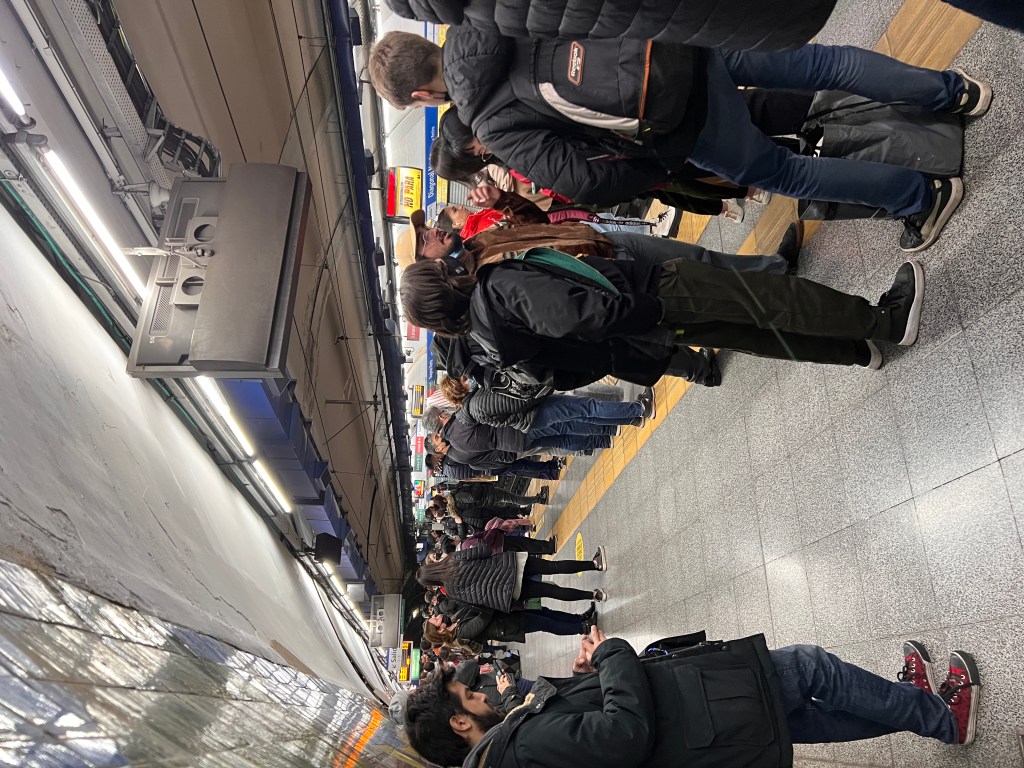
Overall though, the subte system is quick & effective. They have also updated several subte cars, making them feel safer, modern, and reliable.
Going to Argentina soon? Get Ready at a glance:
Get travel medical insurance with SafetyWing.
Book your stay with Booking.com.
Check Flights with Skyscanner or Hopper.
Rent a car with RentalCars.com or Discover Cars.
Download the Airalo app and get an Argentine eSIM.
Purchase the Ultimate Buenos Aires guidebook.
See all my Argentina guides on the Thatch app.
Take a tour with GetYourGuide or Viator.
Have a 1:1 consultation with me in advance!
Subtleties of Line A
For the most part, the stations are where you expect them to be and go in the direction you would expect them to go. Many of the stations allow you to enter from any entrance, and then choose the direction you want to go once underground.
Line A, however, is something special. Underground, the platforms do not connect in the center. So you need to know in advance which direction you’re going, and in turn which side of the street to enter the station on. Line A goes against traffic.
For example, if you’re at the Loria Station wanting to get to Plaza de Mayo, you would NOT enter the subte on the same side of the street as traffic going in the direction towards Plaza de Mayo. Cross the street, as if you were headed to Caballito instead.
Line A also doesn’t stop at every stop. The Alberti and Pasco stations should almost be considered as one station, rather than two distinct stops. The train ONLY stops at Alberti when it’s going away from Plaza de Mayo. Don’t expect to get off there when you’re going towards Plaza de Mayo. The same goes for the Pasco station. The train ONLY stops at Pasco when it’s going towards Plaza de Mayo and not the other way.

Buenos Aires Subte Map App
There is a subte map app that can be (somewhat) helpful, called BA subte. Just note that the app doesn’t seem to have updated since additional stops were added to the yellow line H and purple line E. The app shows the two end stations of line H as Las Heras, but it should be Facultad de Derechos. For line E, the app shows the last stop as Bolivar but it should be Retiro.
Getting On and Off the Subte
The process for getting on and off of the subte is easy. Figure out which direction you want to go, then scan your Sube card on the scanner on top (there is weirdly another scanner on the front side) of the turnstile. Once it turns green, pass through. You do not need to scan your Sube card to exit. The price of one subte ride is currently (2024) 700 pesos, which is about USD 0.80.
Each exit has a number, but it is never very clear what that number corresponds to. If you’re unsure of the exit, your best bet is to use any exit and orient yourself above ground.
Read more: All blog posts about Buenos Aires
Colectivos in Buenos Aires
A city bus in Argentina is called a ‘colectivo‘ or a ‘bondi.’ Bus transportation in Buenos Aires has an extensive system of colectivos, and you can generally expect a bus to come every few minutes. It’s very rare to wait for a city bus longer than 5 minutes (except on Sundays).
The bus system picks up the slack of the subte as far as A to B navigation. Buses can often get you to your location faster and more accurately.
Getting On and Off the Colectivo
Bus transportation in Buenos Aires is also super easy, thanks to the Sube card. When you get on the bus, hold your Sube card to the scanner. The only slightly intimidating thing about taking the bus is that you need to inform the driver where you’re going. That will inform the price.

The best thing to do is check Google Maps before getting on the bus. Look at the name of the street where you plan to get off the bus. Tell the driver the name of that street. He will then push a button, the Sube Card scanner will beep and show a ✅, and you can then move to a seat on the bus.
Enter the bus at the front, and exit the bus using the center and back exit doors. Each pole has an orange and black button. Press that a block or two before your stop, to alert the driver that someone would like to get off.
Buenos Aires has several main bus streets throughout the city. Most of the major avenues have bus lanes that run through the center of the avenue, with their stops clearly marked. They are building several more of these styles of stops throughout the rest of the city. I actually find them very convenient, as it is much easier to find bus stops when they are not camouflaged along the sides of the streets.
Trains in Buenos Aires
Train transportation in Buenos Aires is less used if you are just moving within the city. However, they have their advantages when you’re trying to get out of the city for a weekend or a day trip, especially if you want to go to the Tigre Delta.
The train lines in Buenos Aires generally begin from one of its main train stations: Retiro, Once, and Constitución, and pass through the city on the way to the outskirts and other cities beyond.

- Belgrano Sur: Trains from this line leave from the Dr Saenz Nueva train station in Nueva Pompeya. They head west, ending at Marinos C. G. Belgrano, and Veinte de Julio.
- Belgrano Norte: Trains from this line leave from Retiro and end at Villa Rosa.
- Mitre: Trains on this line start at Retiro and head to San Isidro and Tigre. There is another Mitre train that ends at Zarate. There is also a point at Bartolomé Mitre along the Mitre line, where the train turns into Tren de la Costa, and goes along the coast, ending in Tigre. There is another Mitre train that ends at Capilla del Señor.
- Roca: The Roca train line leaves from Plaza Constitución. This is where you can catch a train to La Plata.
- Sarmiento: Sarmiento trains leave from the Once Station and head west, ending in the towns of Mercedes, and Lobos.
- Urquiza: This train line begins at the Federico Lacroze station in Chacarita. Its last stop is General Lemos.

Taxis in Buenos Aires
The last option for transportation in Buenos Aires is taxis, also known as ‘remis.’
The standard yellow (and black) taxi exists in Buenos Aires. It is usually fairly easy to stand on a main street corner and hail a taxi like in other big cities. Buenos Aires also has its fair share of taxi apps as well.
Taking a regular taxi in Buenos Aires used to be an affordable endeavor. Recently, however, the base prices have increased drastically. Taking a black and yellow taxi is now 4-5x more expensive than using a rideshare app.
For example, a city taxi ride from the Retiro train station to Palermo in a city taxi will cost nearly $20. The same ride using Didi will cost about $4-5.
If you pay with cash, always pay with exact change. Drivers often don’t have the correct change to give you. I suggest taking taxis after sunset rather than trying to navigate public transport.
Taxi Apps in Buenos Aires
- BA Taxi is an app that connects with the official taxi drivers of the city, the ones that drive the obvious-looking black/yellow taxis.
- Uber is also used fairly commonly in Buenos Aires as well.
- Other commonly used taxi apps are: Didi and Cabify.
Note: You can now select car or moto options on both Didi and Uber. The moto option is cheaper than the car option, and it sometimes gets you there faster.
Private Taxi from Ezeiza to Buenos Aires
The taxis at the airport, like any airport in the world, will try to charge you high prices to get to the city center. I personally think it is better to sort out transportation to the city center in advance, after a long international flight.
The driver that I trust the most is named Emilio. His English is very limited, so if you can, speak to him in Spanish, or speak slowly. Contact him a couple of weeks before your flight to arrange pick-up. He is very honest and reliable. I use his services every time. His Whatsapp number is: +54 911 5905 8226. Feel free to tell him that Nicki sent you his way.
Transportation between Jorge Newberry and Ezeiza
Buenos Aires has two main airports. Ezeiza is the biggest airport and is where most international flights will arrive, and is located outside of the city. Jorge Newberry Aeroparque is much smaller and is located near the Palermo neighborhood.
If you need to transfer between these two airports you have three main options:
- Private transfer (ask Emilio)
- Taxi, Uber, Didi (about $30)
- Tienda Leon (about $11)
Tienda Leon is a well-established company that runs buses between the two airports once per hour. They also offer shuttle services to the ferry port and a few stops within the city.
Read more: Free Things to Do in Buenos Aires
Going to Argentina soon? Get Ready at a glance:
Get travel medical insurance with SafetyWing.
Book your stay with Booking.com.
Check Flights with Skyscanner or Hopper.
Rent a car with RentalCars.com or Discover Cars.
Download the Airalo app and get an Argentine eSIM.
Purchase the Ultimate Buenos Aires guidebook.
See all my Argentina guides on the Thatch app.
Take a tour with GetYourGuide or Viator.
Have a 1:1 consultation with me in advance!
Bus Tours in Buenos Aires
If you have just a few days in Buenos Aires and you want to maximize your time without fussing around with public transportation, you could always join a bus tour. Buenos Aires, like most big cities around the world, has a Hop-On/Hop-Off bus service.
The route covers all the main tourist attractions and it’s an efficient way to see all the things to do in Buenos Aires. The ticket allows you to do as much as you want within a 48-hour time period.
Transportation in Buenos Aires Final Thoughts
Buenos Aires is a massive city, so it is common to take public transportation to cross it. If you are only taking taxis or Uber/Didi, things will get pretty expensive for you. Public transportation in Buenos Aires is affordable and a great way to see the city as a local. I hope this Transportation in Buenos Aires guide has helped put you at ease, and you feel more ready to navigate this amazing city!
Pin the photos below to Pinterest for future reference:


TRAVELING SOON?
INSURANCE: Cover yourself with travel medical insurance by SafetyWing.
FLIGHTS: Get the best flight deals with Skyscanner and set flight alerts with Hopper.
STAYS: Check out hotels and apartments with Booking.com and Vrbo.
RENTAL CARS: Get the best deal on rental cars with Discover Cars or RentalCars.
GOING HIKING? Get a 30% discount off your yearly AllTrails+ Account (code: nickiposts30)
eSIM: Get an international eSim with Airalo.
CITY GUIDES: Save time and purchase pre-made city guides with Thatch.
CITY TOURS: Book your tour with GetYourGuide and Viator
LUGGAGE: Get the best carry-on suitcase here.
CREDIT CARD: Start earning travel points with the best travel credit card.
BUENOS AIRES GUIDE: Purchase my Buenos Aires travel companion here.
CONSULTATION: Book a 1:1 travel consultation with Nicki here.
SUBSCRIBE: Get the Nicki Posts Travel Stuff newsletter every month.
TRAVEL BETTER: Check out my Travel Tips and best Travel Resources pages.
MORE? Check out more on my LINKS page to find me in more places!


You must be logged in to post a comment.