21 FREE Things to Do in Buenos Aires
Buenos Aires is a massive city with so many things to get up to. But in this post, you’ll find all the best activities and things to do for FREE.

If you’re coming to Buenos Aires for the first time you might feel a bit overwhelmed with where to start, and what to see and do. So why not start with what’s free and go from there? In this post, I have compiled 21 free things to do in Buenos Aires, which will surely inspire you to do and see more!
I have been coming back to Buenos Aires for years, ever since the first time I taught English here in 2005. I have seen the prices increase drastically over the years, so I know how important it is to be able to find affordable activities in this city, especially if you’re on a tight budget or traveling with family.
Short on Time?
If you’re in a hurry and just want the basics, here is a quick list of things to do in this Buenos Aires city guide:
- Spend a Sunday in San Telmo
- El Ateneo Grand Splendid
- Rivadavia Book Fair
- Cabildo de Buenos Aires
- La Casa Rosada
- El Obelisco
- Centro Cultural Kirchner
- Palacio del Congreso
- La Chacarita Cemetery
- 3 de Febrero Park
- Eco Parque
- Hipódromo
- Barrio Chino
- El Caminito
- Centro Cultural Recoleta
- Floralís Genérica
- Costanera Sur
- Puente de la Mujer
Free Activities in Buenos Aires, Argentina
If you are looking for what to do in Buenos Aires, you have come to the right place. In this blog post, you’ll find 21 free activities in Buenos Aires, organized by the neighborhoods they’re in.
San Telmo
The San Telmo neighborhood is known as the Bohemian area of the city, with some of the older, and certainly more unique architecture. Wandering around San Telmo during weekdays, you might ask yourself where everyone is at. But this neighborhood comes alive in the evenings and weekends, most notably Sundays!
1. Spend a Sunday in San Telmo
San Telmo is known for its antiques and the Sunday Feria de San Telmo, the heart of which takes place in Plaza Dorrego. Throughout the market, you’ll find live tango performances, vintage glassware, mate cups, homemade goods, knives, concert T-shirts, vintage clothing, paintings, etc.
The market extends all the way down Calle Defensa from Plaza Dorrego, for a dozen blocks or so, with a few other market stalls on perpendicular streets.


The streets are full of people wandering, shopping, having coffee at small cafes, drinking beer, having a merienda, and an all-around good ambiance.
While in San Telmo, you can also check out the outside of La Casa Minima, which is the thinnest house in Buenos Aires. Hunt around for the Mafalda statues as well. Have lunch inside the covered San Telmo Market, where you can find several eatery options.
If you want a more in-depth look at this neighborhood, consider taking a San Telmo historical walking tour.
You can even check out what I ate when I spent an entire day in San Telmo:
Caballito
The Caballito neighborhood is a residential area of the city filled with green trees and parks.
2. Rivadavia Book Fair
On the east side of Parque Rivadavia, you’ll find several green kiosks marking the Rivadavia book fair. Though it’s not just books you’ll find, but also records, magazines, and even some video games. Each kiosk is maintained by an individual owner, which means not all kiosks will be open during official hours, but more at the whim of the owner.


You will likely find better prices on books here than in brick-and-mortar bookstores. Bargaining is not a common practice. If you do buy a book, I suggest taking it next door to Parque Rivadavia, along with a blanket and mate to spend the afternoon. This is just one of many great markets in Buenos Aires.
Going to Argentina soon? Get Ready at a glance:
Get travel medical insurance with SafetyWing.
Book your stay with Booking.com.
Check Flights with Skyscanner or Hopper.
Rent a car with RentalCars.com or Discover Cars.
Download the Airalo app and get an Argentine eSIM.
Purchase the Ultimate Buenos Aires guidebook.
See all my Argentina guides on the Thatch app.
Take a tour with GetYourGuide or Viator.
Have a 1:1 consultation with me in advance!
Micro-Centro
The Micro-Centro is like the central business district of the city. This is where you’ll find a lot of the historical places within the city.
3. El Cabildo de Buenos Aires
Location: Bolívar 65 (in the Plaza de Mayo)
Hours: Wednesday- Sunday | 10:30 am – 6pm | Closed on Monday & Tuesday
El Cabildo was once a governmental office, but today serves as a free museum, open to the public. There are several rooms in the main building, as well as a great view of the Plaza de Mayo from the second floor. Behind the main building, you can find an artisan fair, as well as several other rooms showing the history of the place.


This building took a couple hundred years to complete as it was continually started and stopped due to funding issues. Throughout the late 1800’s and the first half of the 1900’s, the building underwent further changes and renovations, as pieces, such as a dome, were removed to make way for the avenues that now run on either side of it, connecting them to Plaza de Mayo. You can find out more inside the museum!
4. La Casa Rosada
Location: Balcarce 50 (Plaza de Mayo)
La Casa Rosada (“The Pink House”) is the center for the offices of the president of Argentina, much like the White House in the United States. However, the Argentine president does not live at the Pink House, but rather in Olivos, outside the city.


The Casa Rosada was originally built as a fort by the Spanish but converted into a governmental building after Argentina gained independence in 1810. One claim states that the building was painted pink in the late 1800s to show compromise between the two main ruling parties, red for Federals, and white for Unitarians.
Juan and Evita Peron famously gave speeches from the balcony of the Casa Rosada, overlooking the Plaza de Mayo.
There are no longer free tours to enter the Casa Rosada, but you can admire the building from afar, or visit the free museum in the back. The museum tells the history of Argentina’s presidents.


5. The Obelisco of Buenos Aires
Location: Av. 9 de Julio s/n (Plaza de la República)
The Obelisco of Buenos Aires sits in the center of the Avenida 9 de Julio, which is the city’s largest avenue (about 14 lanes wide). Once you get to this avenue, it will be obvious which direction to go as it can be seen from quite a distance.
This is one of the best things to see in Buenos Aires because it is such an iconic landmark. If you watched the 2022 World Cup celebrations then you would most likely have seen thousands of people in the streets gathered around the obelisco.


The obelisk was created in 1936 to celebrate the anniversary of 400 years of Buenos Aires. On one side of the obelisk, you’ll see an inscription announcing that this exact spot is where the Argentine flag flew for the first time in 1812. It is not referring to the flag flying on the obelisk, but rather the church that was in this location previously, San Nicolas de Bari.
The best spot to get a photo is on the north side, where you can find the letters “BA” made from plants. Though you may have to wait in line for your turn!
6. Libertad Palace, Domingo Faustino Sarmiento Cultural Center
Location: Sarmiento 151, C1041 CABA
Hours: 2 pm – 8 pm Wednesday – Saturday | Closed on Mondays & Tuesdays
The building used to be called the Centro Cultural Kirchner (CCK) but the name was changed to Libertad Palace, Domingo Faustino Sarmiento Cultural Center after Milei was elected president. You still may see/hear people refer to it as the CCK.


This is a massive building just a couple blocks from La Casa Rosada, next to the Alem & Correo Central subte stations. This was once a postal building that also housed Eva Peron’s office.
It is now a massive contemporary art space with several floors full of exhibits and multi-media art projects. In the center of the space is a massive silver structure. Below that is a space for concerts. Just above is a large platform with changing lights. This is a fantastic spot to spend an afternoon.
Monserrat
This is a neighborhood that is still considered to be “downtown.” It is on the west side of the 9 de Julio Avenue.
7. Palacio del Congreso de la Nación
Location: Av. Entre Ríos (Plaza del Congreso)
This large, imposing building sits on the west end of the Plaza del Congreso. It is where the seat of the Argentine National Congress sits, which is composed of two branches: the senate and the Chamber of Deputies.
This palace was completed in the year 1906, though several details were not completed until 40 years later. The plaza in front of the palace is often a stage for protests due to its proximity to Congress.


The senate offers free tours on Mondays, Tuesdays, Thursdays, and Fridays in English (12 pm) and Spanish (5:00 pm). To find the tour, head to Calle Hipolito Yrigoyen 1863 at the “ventanilla de seguridad” (security window). Bring identification with you, and arrive 15 minutes before the tour’s start time.
Contact info:
Email: visitasguiadas@senado.gob.ar
Phone: 011-2822-3000
Chacarita
The Chacarita neighborhood is an up-and-coming area of Buenos Aires. It is slowly becoming more trendy and more breweries, bars, and cafes are always showing up. It will be a more affordable area to stay in, but you should be more cautious when walking around at night.
8. La Chacarita Cemetery
Location: Av. Guzmán 680
Hours: Everyday 8am-5pm
This cemetery is not as well-known as the Recoleta Cemetery, but it is the largest in all of Argentina. This cemetery was created in the late 1800’s due to a yellow fever epidemic in the country.
The fancier cemetery, La Recoleta, refused to bury those who died from the fever in their plots. Therefore, students from the College of San Carlos created this space as a place to bury those dying from yellow fever. There are now several well-known Argentine writers, actors, composers, comedians, and boxers buried here, including a mausoleum dedicated to all of the fallen players of Boca Jr.


The cemetery is divided almost in half by a tree-lined center street that extends out from the main entrance. Then diagonal rows jut off from the center to create what feels like a small city maze of roads lined with vaults and mausoleums.
If you are going to put this on your free things to do in Buenos Aires list, I suggest going early in the morning to beat the crowds and the direct sunlight.
Palermo
The Palermo neighborhood is one of the biggest in Buenos Aires, and also the most trendy and popular. There is a lot to do in Palermo, especially at night.
9. Tres de Febrero Park
Location: Av. Infanta Isabel 110
Hours: 8 am – 6 pm (winter) | 8 am – 8 pm (summer)


I think this is one of the best parks in Buenos Aires. It’s large and well-maintained. If you’re staying in Palermo, you will be lucky to be able to hop over any time you want for a picnic or a walk through the rose garden.
There is also an Andalucian patio donated by the city of Sevilla, Spain, with its beautiful blue tiles and fountain. According to my friend, you can even see beavers in the lakes, though I did not see any personally!
10. Carlos Thays Botanical Garden
Location: C1425 Buenos Aires, Avenida Santa Fe
Hours: 8 am – 5:30 pm Tuesday – Friday | 9:30 am – 5:30 pm Saturday & Sunday | Closed Mondays
This botanical garden is amazing. It’s is not large, but it is lush and green and makes you feel like you are not in the middle of a city. The garden is full of plants from around the world, as well as statues, and fountains with lily pads. This is one of the best places to visit in Buenos Aires if you’re looking for a little calm.


11. Eco Parque
This long skinny park is just next to the botanical gardens. It was once a zoo and is now a space dedicated to preservation. There are still some animals left over from the zoo such as a camel and a giraffe though. The park is full of peacocks, Mara Patogonica, and several other wild animals.
There are 4D experiences and fountains and guided tours if desired. You can also find bathrooms and cafes here.


12. Hipódromo
Location: Av. del Libertador 4101
This hippodrome, or horse racing track, opened in 1876 to much fanfare. It is free to enter the property 24 hours a day, and there are free public restrooms. There are three races per week, and generally 9 races on each of those days. This space also holds concerts from time to time.
I went on a Saturday evening in the summer and there were food trucks and beer stalls available on the grounds. You can find the racing schedule here.

Belgrano
The Belgrano neighborhood is known as the more upscale and wealthy hood of the city. The streets are wide and covered in trees. You will often see dogwalkers in this area. It feels very safe to walk around.
13. Barrio Chino
Location: Arribeños 2105
This is a great neighborhood to walk around in, get boba tea, and a delicious lunch. You can even find all your favorite Asian cooking ingredients, as there are several Asian supermarkets in this neighborhood.


You can find Barrio Chino in Belgrano, starting with the Chinese arch on Calle Juramento and Calle Arribeños. The arch was assembled in China and then brought over to Argentina piece by piece.
La Boca
The La Boca neighborhood is like the “Little Italy” of Buenos Aires. It’s where the Italian immigrants initially settled many years ago. I suggest staying within the tourist zone of this neighborhood. My phone got stolen by a teenager when I was having lunch about 4-5 blocks away from the main tourist center.
14. El Caminito
Location: Caminito (it’s the name of the street)
Admittedly, this is one of the most touristy areas of the city, but it’s still a great free activity in Buenos Aires. The streets are colorful and full of life. What was once an immigrant neighborhood in Buenos Aires, is now full of tourists, markets, and tango.
There is tango on the street, tango in restaurants, tango painted on the walls, and you can even pay to take a photo with a tango dancer if you’re so inclined.


The restaurants on the main strip of the Caminito are a bit higher than regular Argentine prices, so wander around the colorful neighborhood, which is home to the Boca Juniors, and try out one of the parrillas or cafes on a side street. But don’t take out your phone.
Recoleta
The Recoleta neighborhood is one of the more upscale areas of the city. There are a lot of things to do in Recoleta, all within one small area, so you won’t have to go far to see a lot.
15. El Ateneo Grand Splendid
Location: Av. Santa Fe 1860, Capital Federal
Hours: Monday- Thursday: 9am- 10 pm | Friday & Saturday: 9 am- 12 am | Sunday: 12 pm – 10 pm
This free activity for Buenos Aires is for all you book lovers!
Shockingly, I only visited this incredible bookstore, El Ateneo Grand Splendid, on my second time in Buenos Aires. Somehow I completely missed it the first time around, but I’m so glad life offered me a second chance.


What is now a massive multi-level bookstore, was once a grand theatre that opened in Buenos Aires in 1919. The location of the current cafe in the back of the bookstore is where the stage once was. Travel, health, and young adult fiction books stretch around the walls of what was once a balcony overlooking the stage.
This bookstore truly is splendid. You’re welcome to wander around even if you don’t buy anything.
16. Centro Cultural Recoleta
Location: Junín 1930
Hours: Monday: Closed | Tuesday – Friday: 1:30 pm – 10 pm | Saturday – Sunday: 11:15 am – 10 pm
This cultural center is home to concerts, classes, and art exhibitions. Most of the events are free, and the art exhibitions are on rotation, and free to enter.
On Saturdays, you can find one of the great markets in Buenos Aires just in front of the Cultural Center.


17. Floralis Genérica
Location: Av. Pres. Figueroa Alcorta (Plaza Naciones Unidas)
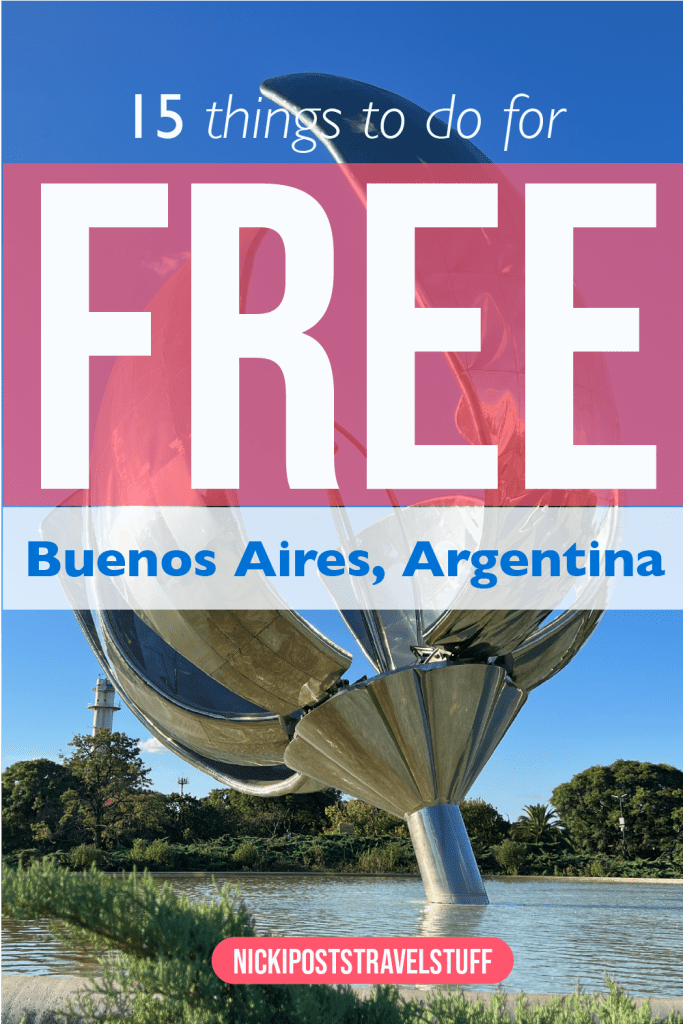
This steel and aluminum flower sculpture was gifted to the city of Buenos Aires in 2002 by the architect, Eduardo Catalano. Surrounded by a reflecting pool, the floralis contains 6 petals, which are connected electrically, and open in the morning (at 8 am), and close in the evening (at sunset).


According to Catalano, ‘Floralis‘ signifies belonging to the flowers, and ‘Genérica‘ comes from ‘gender’ to indicate that it represents all the flowers in the world.
This giant flower is surrounded by a park where Porteños drink mate, have picnics, meet with friends, or take a rest after a bike ride. I suggest bringing a book and a blanket and hanging out for a few hours.
18. Museo Nacional de Bellas Artes
Location: Av. del Libertador 1473
This is a free museum in the Recoleta neighborhood. One section of the museum is dedicated to indigenous art and the history of Argentina. The other portion of the museum has contemporary works and exhibits.


19. Biblioteca Nacional Mariano Moreno
Location: Agüero 2502, C1425
The design of this library is super funky and avant-garde. There are exhibits on multiple levels within the library. You’re free to wander around as you please. But when you enter, you need to show your photo ID. Then they will give you a white card to scan to enter the building. You’ll return it upon exiting.


Activities in Puerto Madero
On the eastern side of Buenos Aires, you’ll find the Puerto Madero neighborhood. This area is very upscale and high-end. You’ll see high-rise buildings, big banks, and swanky restaurants along the water.
20. Puente de la Mujer
Location: Gorriti Juana Manuela 900
The main portion of Puerto Madero is centered around the river with restaurants, bars, and cafes on both sides. There are several bridges crossing over, but the most famous of them all is called the Puente de la Mujer, or Women’s Bridge. It is said that this bridge resembles a woman’s high heel shoe.

21. Costanera Sur and the Reserva Ecológica
Location: C1107 Buenos Aires
If you continue east from the main port section of Puerto Madero, you’ll reach the very edge of the city. Here you can find a great path that goes parallel to the water called the Costanera Sur. All along this path, there are choripan trucks and other food trucks.
On the south end of the path, you can find the entrance to an ecological reserve. This is a beautiful and peaceful place to take a walk or go for a bike ride. You feel very removed from the city here.


Free Activities in Buenos Aires FAQ
Is Buenos Aires worth visiting?
Yes! Buenos Aires is one of the coolest capital cities in the world. Something is going on every day and every night. You can find live rock music, tango, or folk any night of the week. Buenos Aires has culture, history, art, etc. There is something for everyone.
Is Buenos Aires safe for a female solo traveler?
Yes! I have returned to travel alone in Buenos Aires several times. Every time I return, I feel even safer as a woman. A few years ago, the country passed a cat-calling law that will fine men and construction companies if they are cat-calling women on the street. I have also noticed an uptick in female Uber drivers and city bus drivers.
How many days is enough in Buenos Aires?
You could spend years in Buenos Aires and still not see everything, but I can imagine you are planning to spend less time here. The ideal number of days in Buenos Aires is 7-10. But if you don’t have that much time, you can still see quite a lot in just 3 days in Buenos Aires.
What is famous about Buenos Aires?
Buenos Aires is famous for being the birthplace of tango. You can see tango in the streets, as well as at high-end performances. The city is also famous for its food- alfajores, empanadas, and of course the steak. There are hundreds of parrilla (BBQ) restaurants all around the city.
If you speak Spanish, you’ll also notice that people in Argentina have a unique way of speaking. The Argentine accent is much different than that in Mexico, Spain, or any other Spanish-speaking country except Uruguay.
21 Free Things to Do in Buenos Aires Final Thoughts
No matter your interests, you will find something to do in Buenos Aires. This city is busy, hectic, and loud, but it’s also fun, exciting, and full of endless possibilities. I hope you will love Buenos Aires as much as I do. There are so many things to do in Buenos Aires, that you will never get bored.
TRAVELING SOON?
INSURANCE: Cover yourself with travel medical insurance by SafetyWing.
FLIGHTS: Get the best flight deals with Skyscanner and set flight alerts with Hopper.
STAYS: Check out hotels and apartments with Booking.com and Vrbo.
RENTAL CARS: Get the best deal on rental cars with Discover Cars or RentalCars.
GOING HIKING? Get a 30% discount off your yearly AllTrails+ Account (code: nickiposts30)
eSIM: Get an international eSim with Airalo.
CITY GUIDES: Save time and purchase pre-made city guides with Thatch.
CITY TOURS: Book your tour with GetYourGuide and Viator
LUGGAGE: Get the best carry-on suitcase here.
CREDIT CARD: Start earning travel points with the best travel credit card.
BUENOS AIRES GUIDE: Purchase my Buenos Aires travel companion here.
CONSULTATION: Book a 1:1 travel consultation with Nicki here.
SUBSCRIBE: Get the Nicki Posts Travel Stuff newsletter every month.
TRAVEL BETTER: Check out my Travel Tips and best Travel Resources pages.
MORE? Check out more on my LINKS page to find me in more places!




You must be logged in to post a comment.