Cafayate To Salta | What You Can See Along Ruta 68
The Cafayate to Salta Ruta 68 is one of the most beautiful drives in the country of Argentina, where you can see amazing red rock formations.

Salta is one of my favorite provinces in all of Argentina. Because it is so far north and so dry, it is the perfect location for growing wine, like you can find in Cafayate. The desert landscapes also make for some pretty incredible views and jaw-dropping drives.
The scenic drive along Ruta 68 between the capital city of Salta and Cafayate is easily one of the best drives in the country. The drive itself takes 3 hours, but you should be prepared to get out of the car several times to do some exploring in the area. I have done this drive multiple times, and it never gets old.
This post will show you all of the amazing places and attractions that you can see along Ruta 68, as well as what to do and where to stay in both Salta and Cafayate.
Short on time?
Basic Info
- Cafayate to Salta distance: 197 km
- Cafayate to Salta time: 3 hours
- Planned time for stops: 5 hours
Main attractions
- Los Colorados
- Shell’s Ravine
- Los Castillos
- Las Ventanas
- El Obelisco
- La Yesera
- El Fraile
- El Sapo
- Mirador Tres Cruces
- El Anfiteatro
- La Garganta del Diablo
Going to Argentina soon? Get Ready at a glance:
Get travel medical insurance with SafetyWing.
Book your stay with Booking.com.
Check Flights with Skyscanner or Hopper.
Rent a car with RentalCars.com or Discover Cars.
Download the Airalo app and get an Argentine eSIM.
Purchase the Ultimate Buenos Aires guidebook.
See all my Argentina guides on the Thatch app.
Take a tour with GetYourGuide or Viator.
Have a 1:1 consultation with me in advance!
Where is Ruta 68 located?
Ruta 68 is the road that goes between Cafayate and Salta through La Quebrada de las Conchas. While the whole route is beautiful (except as you near Salta), the majority of the red rock formations and attractions lie much closer to Cafayate.
Route 68 is paved between Salta and Cafayate, so you don’t need to worry about dirt roads or getting a flat tire, like you do on the nearby Ruta 40.
Map of the area
How do I get from Salta to Cafayate?
The drive between Salta and Cafayate is along an asphalt road so it is a very smooth ride. The most common ways to travel between the two cities are to take a bus or rent a car. If you have a car you can stop at as many places as you want.
Cafayate to Salta Bus
Several buses per day travel between Salta and Cafayate. The most common bus company is the FlechaBus. You can check bus schedules on BusBud. When booking your ticket, I suggest selecting one of the four seats on the top level in the front row. They are usually seats 1, 2, 3, and 4. This gives you a great view of the scenery.
The bus takes 3.5 hours.

Cafayate a Salta Driving
If you want to rent a car, I suggest renting from the Salta airport, which is the biggest airport in the area. It takes 3 hours to drive directly from Salta to Cafayate. However, you will want to get out and take photos, and see the formations. So I suggest planning for 5-6 hours of total travel time.
This is one of the best drives in the North of Argentina, and you should absolutely add it to your Salta itinerary.
Cafayate To Salta | What You Can See Along Ruta 68
I have driven this route multiple times and still love it! The first time I passed through on a bus so I could only admire the formations from afar without stopping. The second time I went was in the fall (June 2022). My friend had a car and we made several stops.
The third time I went was in the spring (November 2024). I was traveling with a friend, and we also rented a car. I was so excited to show him this route and all its beauty. It was really interesting to see the way the landscapes changed throughout each season. Of course, in the spring, there were a lot more people doing this route as well.
Both Salta Capital and Cafayate are cities within the province of Salta. You can do this drive as a day trip from the capital city of Salta down to Cafayate. However, I recommend staying for a few days, as there are so many things to do in Cafayate. The following list is in order if you start from Cafayate and drive north towards Salta.
1. Los Colorados
Los Colorados is the first attraction you’ll see when you leave Cafayate. There is a space to pull over to the right and park. You can walk along a small path to admire these giant red rocks and the surrounding cacti. You are not allowed to climb up these small mountains, and they have it blocked off.


2. Shell’s Ravine
The next stop is marked on the map as the Shell’s Ravine (Quebrada de la Concha), which is also the name of the area. It is located just a few minutes down the road from Los Colorados. Here you can climb on top of the rocks and get a great view of the area from the peak.


3. Mirador Los Castillos
This lookout point allows you to see the amazing precipices called “The Castles” from a distance. There didn’t appear to be any trails to get you closer, and the rocks were on the other side of a river. However, you can get a nice view from the lookout spot on Google Maps.

4. Las Ventanas
The name suggests there are plural “windows,” but from this viewpoint, you can only see one of them. You’re not allowed to climb all the way up to the hole and must just admire it from afar. In 2022, I was allowed to get closer to the base, but by 2024, they had added a sign and a small fence to keep us further back.
Apparently, there are other “windows” that are further back in the canyon behind this window, but you need a local guide to bring you back there.


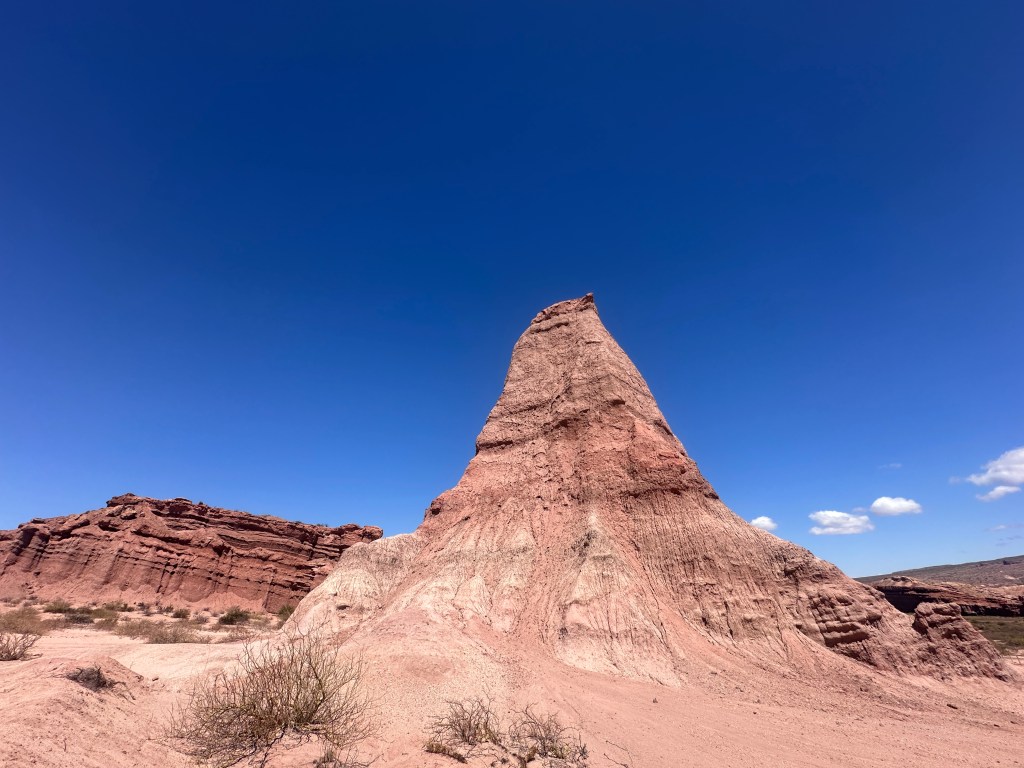
5. El Obelisco
This obelisk is just as its name suggests- a tall, pointy structure similar to the obelisco in Buenos Aires. There is a fence all the way around it, so you can’t get very close. But you can take the small path around the circle. If you want to keep walking, there is a path that continues into the red rocks behind it.
6. La Yesera
La Yesera are rock formations with several layers of different colors. In order to see them better, you need to follow the Senda las Estratos Trail for about 10 minutes. This will take you to the ridge above the lower portion. There are also trails down below if you want to go deeper into the area.


7. El Fraile
El Fraile means “the friar.” It is more of a rock face with some patterns that come alive if you look really hard, like those eye-scrambling digital prints of the 1990s. I personally didn’t see the shape of a friar or what was supposed to represent a friar, but the rocks are beautiful nonetheless.

8. El Sapo
El Sapo is a natural rock formation that looks like a giant toad. Someone has even added white rocks where its eyes should be. There is a fence around the toad, so you can’t get super close to it, but it is cute to admire from a distance.


9. Mirador Tres Cruces
This is one of the more popular spots to stop and admire the view. There is a small parking lot at the bottom near the road, and you’ll see small tour buses stopping here. There are also locals selling handicrafts and playing “The Sound of Silence” on a small flute on repeat.
You need to walk up a small hill in order to reach the peak, but from there you are treated to spectacular views of the valley down below and the mountains in the background. It was nice to see the contrasts of the deeper greens against the red rock in the spring which was less present when I went in the fall.


10. El Anfiteatro
This is one of the most popular stops along the Camino a Cafayate, road to Cafayate. There is a giant parking lot to accommodate the many cars and visitors who are here at once. There are several artisans selling handicrafts and musicians inside this giant bowl playing music, which sounds truly spectacular in this natural amphitheater.


11. La Garganta del Diablo
There are many places in Argentina named La Garganta del Diablo (The Devil’s Throat), so this is not to be confused with the waterfall in Tilcara or the most famous spot in Iguazu Falls.
This Garganta del Diablo is the most well-known of all the stops along this Salta road trip up Ruta 68. You can climb up the rocks here, and it just seems to keep going back and back. Make sure to wear sneakers when you’re climbing on the rocks because there are several very steep parts here.
Because this is the most popular stop, there is also a very large parking lot and several vendors selling jewelry, musical instruments, etc., along the passage into the Devil’s Throat.


Money in Salta
Dealing with money in the Salta province is not complicated. Most places take credit cards and debit cards. You can also find a Western Union in the larger cities like Salta, Cafayate, Tilcara, etc. It will be more challenging to find a Western Union in smaller places like Iruya or Purmamarca.
I suggest having cash for smaller places in Salta, and for buying street food or for leaving tips. Some places will charge a 5-15% fee for using a credit card, so having cash could cancel that out. Sometimes they even offer a discount if you pay in cash.
Travel Insurance for Traveling in Argentina
It is definitely a good idea to get travel insurance when you go to Argentina. You never know what could happen. For my physical health, I use SafetyWing.
I use SafetyWing, which is great travel medical insurance created by nomads for nomads. You can sign up for as many days as you need, and cancel whenever you want. They have particularly good prices, especially for those under 40 years old. Check them out here.
Best Time To Visit Salta
I have traveled around the Salta province in both fall and spring, and can say confidently that I enjoyed my time in both seasons. But if I had to choose, springtime is better. There is more greenery, and the vibe of the city feels more cheerful in spring than in summer. Also, the wineries in Cafayate are so much more impressive and pretty.
Many of the smaller towns in the Salta province have large Carnival celebrations so things book up fast around that time period. The dates of Carnival change each year so make sure to check a calendar for exact dates. It usually falls around February or March.
There are fewer tourists in the colder months (April – September), and prices tend to go down. There is less competition for booking accommodation in advance. In the spring months (October – December), tourism begins to build, and you’ll see a lot more travelers (foreign and domestic), especially in Cafayate.
Salta Capital
Salta is the capital of the Salta province. It is known as “Salta La Linda” (Salta, the beautiful). It really does become beautiful in the spring. The whole city becomes green, and you can hear the sounds of cicadas as you stroll through the park.
What to do in Salta
You can easily see the main tourist attractions in the city of Salta in 1-2 days. Here is what I recommend:
- Take the funicular to the Cerro San Bernardo
- Stroll through the markets in Parque San Martín
- Eat the local foods (especially tamales & humitas)
- Have coffee or get a shoe shine in Plaza 9 de Julio
- Visit the cabildo and other museums in Plaza 9 de Julio
- Take a day trip to Villa San Lorenzo
Where to Stay in Salta
Here are a few great places to stay in Salta:
Cafayate
Cafayate is the town for visiting the wine region in the north of Argentina. I personally prefer this wine region over that in Mendoza, even though Mendoza gets the most fame. It was great to visit in the fall because the town was so quiet. But it was amazing to visit in the spring because everything came to life, and it was stunning.
What to do in Cafayate
Here are a few suggestions for what to do in Cafayate:
- Take a wine tour at Piatelli vineyards (reserve in advance)
- Have lunch at Finca las Nubes (no reservation required)
- Try the cheese/wine taster set at Cabras de Cafayate
- Do those tastings at the bodegas in town
- Go hiking at Camino de los Siete Cascadas
Where to Stay in Cafayate
Cafayate is a small town, so almost everything is easily walkable. Here are my suggestions:
- Hospedaje Los Cardones (I stayed here and enjoyed it)
- Hotel Asturias (I stayed here and loved it!)
- Piatelli Resort (Treat yo self!)
Organized Tours in Salta Province
Cafayate to Salta FAQs
Here are a few final questions regarding the trip from Cafayate to Salta.
How long does it take to drive from Salta to Cafayate?
If you drive without stopping, it takes 3 hours to drive from Cafayate to Salta. However, if you are driving on Ruta 68, it would be criminal to just pass by without stopping at several of the rock formations and vista points. Therefore, I suggest giving yourself 5-6 hours to drive this route.
Can you walk this route?
It is not suggested to walk along Ruta 68. The rock formations worth seeing are spread out over several kilometers. It is also in the middle of the desert. There are no gas stations along the way to buy water or other items. It is strongly suggested to take a tour, rent a car, or rent a bicycle.
Is the Cafayate to Salta route worth doing?
Yes! Driving along Ruta 68 is so beautiful. I loved it so much that I did it more than once, and was really excited to share the experience with a friend who came back to Argentina to travel with me. Not only do I love the north of Argentina, but this route is one of my favorite places in all of Argentina.
What is Ruta 68 famous for?
The most famous formations along this route are the Garganta del Diablo and the Anfiteatro. They are the tourist attractions with the biggest parking lots and the most vendors outside waiting to sell their goods. If you have time for only a couple of stops, make it at these two points.
Final Thoughts on Cafayate to Salta
Whenever I think about the north of Argentina, I get really excited, and it is partly because of what you can see along Ruta 68, and what is at both ends of it. Cafayate is an amazing small town with dozens of bodegas and wineries. Salta is a vibrant city with a lot of history and old buildings. The Ruta 68 that connects them is stunning.
I hope that I have convinced you to take Ruta 68 from Cafayate to Salta to see all of these amazing red rock formations in the desert of Argentina. You won’t regret it!
TRAVELING SOON?
INSURANCE: Cover yourself with travel medical insurance by SafetyWing.
FLIGHTS: Get the best flight deals with Skyscanner and set flight alerts with Hopper.
STAYS: Check out hotels and apartments with Booking.com and Vrbo.
RENTAL CARS: Get the best deal on rental cars with Discover Cars or RentalCars.
GOING HIKING? Get a 30% discount off your yearly AllTrails+ Account (code: nickiposts30)
eSIM: Get an international eSim with Airalo.
CITY GUIDES: Save time and purchase pre-made city guides with Thatch.
CITY TOURS: Book your tour with GetYourGuide and Viator
LUGGAGE: Get the best carry-on suitcase here.
CREDIT CARD: Start earning travel points with the best travel credit card.
BUENOS AIRES GUIDE: Purchase my Buenos Aires travel companion here.
CONSULTATION: Book a 1:1 travel consultation with Nicki here.
SUBSCRIBE: Get the Nicki Posts Travel Stuff newsletter every month.
TRAVEL BETTER: Check out my Travel Tips and best Travel Resources pages.
MORE? Check out more on my LINKS page to find me in more places!


You must be logged in to post a comment.